

The AI Acceleration Curve Just Went Vertical
New benchmarks suggest artificial intelligence may be approaching a major capability leap
For the past two years, artificial intelligence has been improving steadily.
Models got smarter. Hallucinations declined. Context windows expanded. Coding ability improved.
But in 2026, something different is happening.
The curve is bending upward.
Look at the benchmark data highlighted during Google’s recent Gemini 3.1 Pro launch, and you’ll see scores that would have been considered science fiction just 18 months ago:
- 94.3% in scientific knowledge testing
- 77.1% in abstract reasoning puzzles specifically designed to be hard for AI
- 85.9% in agentic search
- 84.9% in long context performance
- And in expert task evaluation, Claude Sonnet 4.6 is sitting at 1633, leading the pack here entirely.
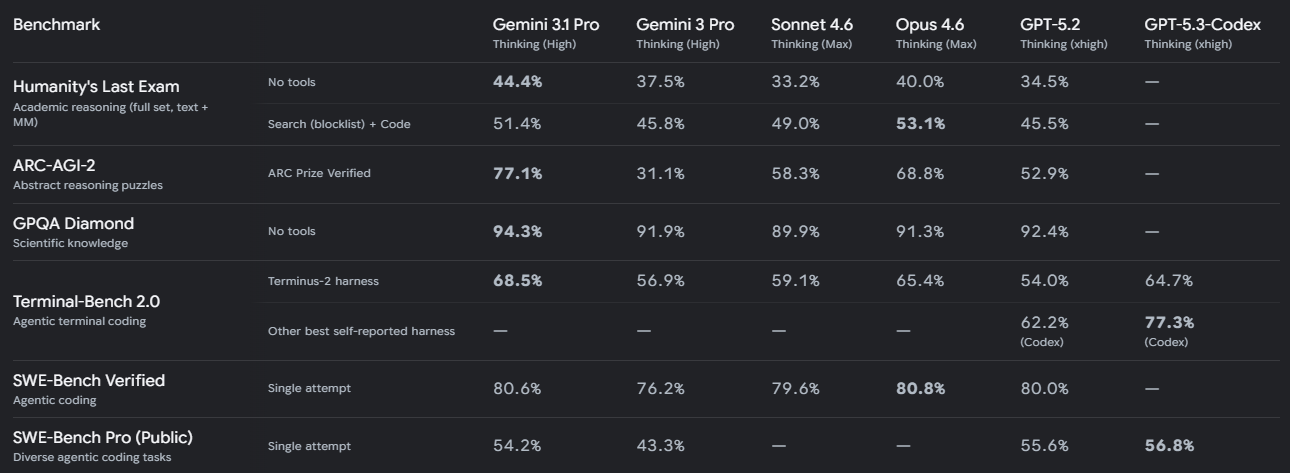
When leading labs are posting major benchmark scores that would have represented the outer limit of credibility in 2025, you’re no longer looking at marketing. You’re looking at a trend.
Right now, the METR time-horizon data may be the most important chart in technology. It measures something far more concrete than benchmark scores: how long an autonomous AI agent can sustain productive work on real engineering tasks.
And that line has gone nearly vertical.
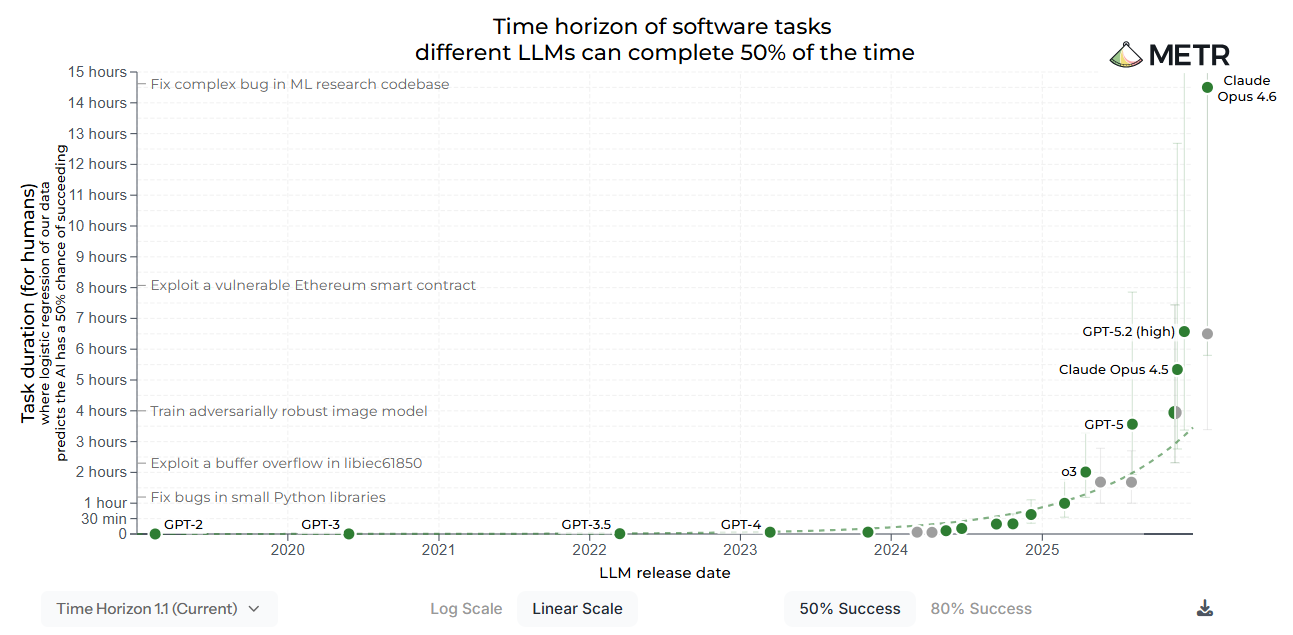
From minutes to hours in roughly three years. From two hours to 14 hours in just 12 months.
If we follow that curve, we arrive at something that looks like full-day, then full-week autonomous operation within a year or two.
In other words, the Great AI Acceleration has begun…
Which means the economy may soon face a stress test so severe, it makes the shocks of 2008 look modest in comparison.
Why AI Leaders Are Suddenly Talking About AGI
The most telling signal isn’t public benchmarks. It’s how the insiders are talking.
Frontier AI leaders Sam Altman, Dario Amodei, and Demis Hassabis have all recently suggested that artificial general intelligence may be closer than the consensus believes.
In simple terms, AGI refers to AI systems capable of performing most knowledge-based tasks at or above the level of a typical human professional – autonomously and at scale.
These are people with access to internal capability evaluations that the public never sees, who have fiduciary duties to their investors, and who have spent years carefully managing expectations.
The obvious counterargument is that they have every incentive to hype their own products.
That’s fair. But consider what they’d actually gain from exaggerating timelines right now: regulatory scrutiny, congressional hearings, spooked employees, and a credibility problem when the timeline slips.
The risk-reward on dishonest AGI boosterism is not great. So, when insiders sound alarmed, we should take that seriously, not dismiss it.
Follow the $710 Billion In AI Infrastructure Spending
But even if we feel like we can’t trust the words, we can follow the money – because cash doesn’t lie.
Combined hyperscaler capital expenditure for 2026 is now tracking toward $710 billion. That is not speculative enthusiasm. That is Microsoft (MSFT), Alphabet (GOOGL), Amazon (AMZN), Meta (META), and Oracle (ORCL) making multi-year, balance-sheet-altering commitments to build the infrastructure for something they clearly believe is coming.
These companies have CFOs and boards and shareholder accountability. They don’t write $710 billion checks on vibes.
Layer on top of that Anthropic closing in on a $30 billion raise and OpenAI raising capital at valuations approaching $100 billion. The venture community is making directional bets with real money at a scale that implies genuine conviction about near-term transformative capability.
CEOs can posture. Venture capital can exaggerate.
But $710 billion in hyperscaler capex is not theater. It’s preparation.
And the market is beginning to understand that.
What the Stock Market Is Saying About AI
The IGV software ETF is down 24% year-to-date – one of its steepest drawdowns since the 2008 financial crisis. Meanwhile, the broader market is essentially flat.
A 24-point divergence between a sector and the market is a verdict.
The market is concluding that traditional software businesses – the enterprise Software-as-a-Service (SaaS) stack that has powered a generation of wealth creation – are facing an existential question about their reason to exist.
If AI models become genuinely capable of performing most knowledge work tasks autonomously – as the current trajectory suggests – then the question isn’t whether software stocks are oversold. The question is which software companies are building the picks and shovels for the AI era – and which are selling products that AI will simply replace.
That is not a subtle distinction. And it’s exactly why the market is reallocating.
But how soon does ‘replacement’ become reality?
The AI Acceleration Timeline: How Close Is AGI?
The METR data suggests we may not be far away from achieving AGI.
It is the kind of timeline that feels simultaneously urgent and abstract, which is precisely why most people will not take it seriously until it is too late.
If AI reaches AGI-level capability within two years, the economic consequences bifurcate sharply along a single axis: do you own AI capital, or do you sell labor that AI can replicate?
For those on the capital side of that line, the profit potential is extraordinary. AI doesn’t work for pay or take sick days. It scales instantly and degrades gracefully. A company that swaps AI for knowledge workers rewrites its margin structure. Payroll becomes compute. Compute scales, and margins expand. For shareholders in true AI-native businesses, that’s the holy grail: growth and operating leverage at the same time.
For those on the labor side, the contrast is stark and much more grim. Previous automation waves displaced physical workers over decades – long enough for retraining, for new industries to emerge, and for society to absorb the shock. But this AI wave is targeting knowledge workers, who have historically been the beneficiaries of automation rather than its victims; and it is moving on a timeline measured in years rather than generations. The social safety nets, retraining programs, and political institutions that might buffer that displacement were not designed for this scenario.
The result, if left unaddressed, is a society stratified not by education or skill but by proximity to AI capital: a techno-feudal order, if you will, in which the owners of the models are the lords, and everyone whose labor the models can replicate are the serfs.
It is not a pretty picture.
And while it is also not an inevitable one – since policy, redistribution, and political will can alter this trajectory – the window to shape that outcome may be narrower than most realize… and closing fast.
How Investors Are Positioning for the AI Economy
The investment implication here writes itself: if AI is the new engine of wealth, you want to own the engine.
Own the model builders, the infrastructure providers, the companies that are genuinely AI-native rather than merely AI-adjacent.
This is the obvious trade for a reason; but there are also a few caveats to keep in mind.
- Obvious trades are rarely as clean as they appear. The AI buildout requires $710 billion in capex that needs to generate returns. Open source models are closing the capability gap with proprietary ones. The economic surplus from AI may be competed away faster than expected, benefiting end consumers rather than model builders. Being right about the technology does not automatically make you right about the investment.
- AI valuations already reflect significant optimism. You are not discovering something the market doesn’t know. You are expressing a view about the magnitude and pace of what the market has already partially priced.
- The thesis that leads us to ‘invest in AI stocks‘ is the same that suggests the society we’re investing in is about to undergo extreme disruption. Positioning ourselves on the capital side of that divide is a rational response to the world that may be emerging. It is also worth acknowledging that this new world is not a good one for most people.
The Bottom Line
The Great AI Acceleration is upon us.
The question is not whether AI will be transformative. The question is how fast, how concentrated, and how prepared any of us are for what comes next.
The METR chart is the most important chart in the world right now. A line that started near zero and has gone nearly vertical is, historically speaking, the kind of line that does not stop on its own.
We are, in all probability, in the early stages of something that will make the internet revolution look like a warm-up act.
The techno-lords are assembling their estates. If you don’t want to be collateral damage, be very careful where you park your capital.
And right now, the most important estate in AI isn’t public. It’s OpenAI.
Reports suggest a 2026 IPO is coming. And when OpenAI goes public, it could be the most anticipated IPO since Facebook – and potentially the first trillion-dollar AI debut.
History is clear: the biggest gains don’t go to the investors who buy on IPO day. They go to the ones who positioned themselves before the public even gets access.
I’ve identified a little-known way to do exactly that – for under $10.
If you’re going to pick a side in the AI revolution, this is the one event you can’t afford to ignore.