
Stop Guessing the Market. Use AI Trading Signals Instead
Why the best investors don’t predict direction – they follow patterns hidden in data
Editor’s Note: Most investors are trained to ask a simple question: Is the market going up… or down?
While it seems logical, that can actually lead you in the wrong direction. Because the best investors – the ones who consistently win – don’t try to predict the market. They look for repeatable signals… patterns that create profitable trades in any environment.
In today’s guest essay, TradeSmith CEO Keith Kaplan shares how his team is using AI to scan thousands of stocks and identify those high-probability setups, inspired by the same signal-driven approach that powered some of the world’s top hedge funds.You can explore the system yourself right now – search stocks, view active signals, and see how it works – ahead of Keith’s free event on Wednesday, April 22, at 10 a.m. Eastern. Reserve your spot and get access here.
Are you bullish or bearish?
As an investor, it’s a question you hear a lot.
A brother-in-law asks you at a family barbeque. A CNBC anchor asks a bigshot economist which way the market is headed. Or your broker sends you his annual outlook.
Heck, every week going back to 1987, the American Association of Individual Investors has asked its members which direction they think the market is headed over the next six months.
Millions of investors all asking the same question – and all missing the point.
The bull-or-bear question is a rookie trap.
Professional investors – especially the folks inside the world’s most profitable hedge funds – don’t think in these terms. They look for ways to profit whether stocks are going up or down.
Nobody understood this better than Jim Simons.
He didn’t build the most profitable hedge fund in history, Renaissance Technologies, by trying to predict the direction of the market. Instead, he used advanced algorithms – and reams of market data – to unearth repeating “signals” in stocks that point to high-probability trade setups.
Bull market or bear market, it didn’t matter. The signals worked either way.
It’s the same principle behind the new AI-powered trading system my team and I at TradeSmith have spent more than a year developing.
It’s inspired by Simons’ search for signals. And the results have blown us away.
In a five-year backtest, a model portfolio of these signals trades turned $10,000 into $1.2 million.
And in 2022 – the worst year for stocks in half a century – they produced an average gain of 16.6% while the S&P 500 fell nearly 20%.
I’ll show you more about how it works in a moment. Better still, I’m giving you access to a beta version of our software so you can try it for yourself.
First, it’s important to understand how Simons pioneered this unorthodox trading technique. Back in the late 1970s, it started in a cramped office in a Long Island strip mall – about as far from the glitz of Wall Street as you can get.
The Search for Unique Signals
Simons had just walked away from his tenured position heading up the math department at Stony Brook University. And he was running his fledgling trading firm out of a nearby shopping center.
He wasn’t interested in earnings reports or analyst forecasts. He knew that if you did what everyone else was doing, you’d get the same returns as everyone else. He wanted to beat the market, not just track it.
So, he looked for unique signals – obscure, repeatable patterns buried in reams of market data that pointed to predictable moves.
To find them, he didn’t hire Wall Street traders. Instead, he hired mathematicians, physicists, and – notably – two IBM scientists who spent their careers building speech-recognition models.
They’d been building computer models to predict the next word in a sentence based on patterns in prior text. Simons told them to apply the same logic to stocks.
Renaissance Technologies averaged 66% annual gross returns over the next four decades. This made it the most profitable hedge fund in history.
For obvious reasons, Simons wasn’t in a rush to share his secrets. So, this market-beating approach stayed locked inside a handful of elite hedge funds, widening the wealth gap instead of narrowing it.
But over our 21-year history, our mission at TradeSmith has been to put hedge-fund-level tools in the hands of regular investors. And with our latest innovation, we’re blowing that Wall Street secret wide open…
We’ve Never Gone This Deep Before
We’re a financial technology firm based in Baltimore that develops hedge-fund-level analytical systems for self-directed investors.
More than 134,000 people in 86 countries use our software to manage more than $29 billion in assets. And we’re always innovating — testing trading strategies, financial metrics, and data patterns to uncover profitable systems and indicators.
That’s what’s gotten us featured in Forbes, The Wall Street Journal, and The Economist.
It started with our risk-management software, TradeStops. It takes the emotions out of investing by showing you the ideal time to sell your stocks.
We’ve also created software that spots hidden seasonality patterns in stocks… finds undervalued options plays… and uses AI to forecast stock moves up to 21 trading days out.
But our new system goes deeper than we’ve ever gone before.
It evaluates 2.09 million potential trades a day across 2,467 stocks. It runs each one through 847 individual calculations, hunting for the same kinds of signals Simons built his career on.
When the right combination of factors aligns, our system flags it as a high-probability trade setup.
The results speak for themselves.
Real Examples of AI Trading Signals In Action
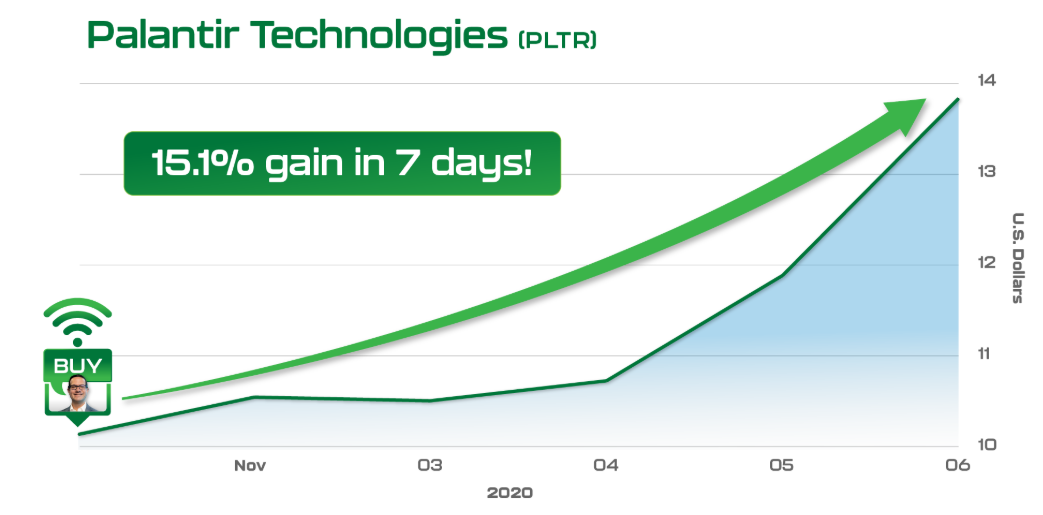
For instance, on October 30, 2020 – with markets rattled by a new COVID variant – the same system flagged a Palantir Technologies Inc. (PLTR) thumbprint with a 95% historical success rate.
It showed that every time Palantir had gone down at least three days in a row… its daily price swings were shrinking… and at least 5,000 U.S. hospitals were accepting new patients… the stock was on the verge of a jump.
The forecast called for a 5.8% gain in nine days. The backtested result was even better: 15.1% in seven days.
What do hospital numbers have to do with Palantir’s share price?
It turns out, a lot.
Palantir’s biggest clients at the time were hospitals. With about 6,100 hospitals operating across the U.S., a drop below 5,000 open facilities would be trouble for the company’s revenue. When hospital numbers fall, Palantir’s business feels it – and so does its share price.
Our system is built to find those kinds of connections. Not the hospital figures themselves, but the imprints they leave behind in the data.
And remember, this signal fired during the pandemic. Which brings me to an important point about how it works…
Bull or Bear Market: AI Trading Signals Work In Any Environment
No one knows exactly why each signal has a history of preceding a big move.
And frankly, it doesn’t matter. Our system is looking for alignments that have worked before – even when there’s no obvious reason why.
That means this new kind of trading system doesn’t care whether we’re in a bull or a bear market. It doesn’t need a strong economy or a calm geopolitical environment. It just needs certain factors to align.
One example is a signal on Walmart Inc. (WMT) that has fired 24 times over the past decade – a rare alignment of three specific conditions in the stock’s price history.
WMT has to reverse its trend one day… hit a higher high and a lower low the next day… and then close down for the day. When those specific factors align, it’s gone on to post a winning trade 92% of the time.
This signal worked in the bull market of 2019 and the bear market of 2022. It even worked in 2017, after one of Walmart’s worst earnings reports in a decade.
That’s what makes it so powerful today. With oil hovering above $100 a barrel… and rising stock market volatility… you don’t want to be relying on a system that only works in good times.
I’ll walk you through how it works in more detail – including the patterns it’s tracking right now and the trades it’s flagging for the weeks ahead – during our launch event.
It kicks off Wednesday, April 22, at 10 a.m. Eastern. So make sure to clear some time in your calendar and register your interest.
We’ll not only hold your spot. We’ll also give you immediate access to the new beta version of our software ahead of the event.
Go here to register for the launch and take it for a spin. You can use it to find active signals on thousands of stocks – at no charge – from now until April 22.
We’ve been working on this new trading system for the past 12 months. And since becoming CEO of TradeSmith, I’ve never been more excited about what we’re about to reveal. So, I hope to see you there.