

The Space Economy Is Lifting Off – And These Undervalued Stocks Are Riding Shotgun
If this space economy thesis plays out, the upside will vastly outweigh any individual misfires
Let’s talk space stocks – because names like Rocket Lab (RKLB), AST SpaceMobile (ASTS), Planet Labs (PL), and BlackSky (BKSY) have been on a tear lately.
Since early April, all four of these names have more than doubled – in just three months – led by a nearly 215% gain in BSKY stock.
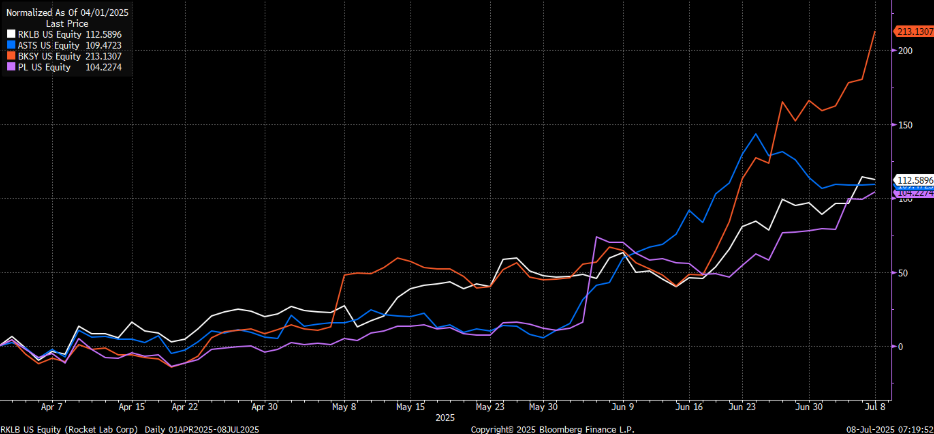
And despite this surge, we think they’ve still got miles of orbital runway left.
Why? Because the space economy is finally getting real. It’s no longer some far-off “Jetsons” fantasy.
Space is becoming a new layer of our economic infrastructure, as foundational as electricity, railroads, or the internet.
For decades, we launched satellites into orbit mainly for GPS and weather reporting. But that is now in the past.
The future? We’re building an entirely new economy in space – and rockets are the foundation.
Just like fiber optic cables enabled the digital economy, rockets and satellites are enabling the orbital economy.
And innovations in this space are starting two powerful, fast-growing, and, most importantly, monetizable verticals: National Security and Communications.
We see this unlocking a massive economic opportunity. In fact, McKinsey and the WEF estimate the global space economy – including launch, satellites, navigation, and space-enabled services – will reach ~$1.8 trillion by 2035.
If you’re hoping to get invested in this space-centered future, there are several compelling sectors to watch.
How the Space Economy Is Transforming National Defense
Let’s start with the national security angle first.
Governments are waking up to the uncomfortable fact that space is the new strategic battleground.
Satellites can now provide real-time battlefield intelligence, secure military communications, early warning missile detection, navigation and targeting systems, and surveillance on rival (and even friendly) nations
Just look to Ukraine – its military would likely have been wiped off the map without Starlink – or China, which now considers satellite dominance a national priority.
Even the Pentagon has created a $30-plus billion annual budget line called the U.S. Space Force.
This is a long-term arms race – one that favors nimble, responsive space companies with launch capacity, satellite imaging capabilities, and hardware manufacturing.
Who benefits here? The usual suspects.
- BlackSky, which provides real-time Earth intelligence for military and defense
- Planet Labs, operator of the largest constellation of Earth observation satellites
- Rocket Lab, launch provider for government payloads, hypersonic testing
- Palantir (PLTR), which offers analytics for satellite data
The bottom line? We estimate national defense TAM in space is about $30- to $40 billion today. But as intelligence demand and geopolitical tensions escalate, it could easily double over the next decade.
And it’s just one vertical of the multi-faceted Space Economy…
Space-Based Internet Will Revolutionize Communications
Another big vertical here is space-based communications because the entire communications industry is being rewritten from orbit.
The world is moving toward a space-powered internet: a global, always-accessible broadband network delivered from thousands of small satellites in low Earth orbit (LEO).
This isn’t a theoretical future. It’s already in action:
- Starlink has launched over 6,000 satellites and serves millions of users worldwide.
- Amazon’s Project Kuiper is gearing up to launch a 3,000-plus satellite constellation to support AWS and global internet.
- AST SpaceMobile is going one step further, building the first cell tower in the sky that connects directly to your smartphone without dishes or terminals.
That’s a major step up, especially considering that 2.6 billion people worldwide still lack reliable internet access, and billions more suffer from poor mobile coverage.
Not to mention, we still don’t have cell coverage on airplanes. And natural disasters like earthquakes, fires, and tsunamis often knock out cell coverage when we need it most.
That’s why we think the total addressable market here is huge. We see it climbing toward $150 billion by 2035 – possibly much more if these constellations become the backbone for rural broadband, global telecom, and even cloud connectivity.
Who benefits?
- ASTS – offers direct satellite-to-phone coverage in partnership with AT&T, Vodafone, and Telefonica
- RKLB – launching communications satellites for multiple players
- PL & BKSY – may support telecom mapping, planning, and routing
- SpaceX – But it’s private… for now. Platforms like Robinhood (HOOD) and SoFi (SOFI) are launching new funds to allow retail clients to invest in private firms like this one.
Between national defense and communications, we’re already staring at a $50- to $65 billion market in space today.
And it’s still very early days.
A Deeper Look at What the Space Economy Has to Offer
This is all great news for RKLB, PL, BKSY, and ASTS. That’s why those stocks are ripping higher.
But those are likely just the first two puzzle pieces to unlocking profits within the trillion-dollar space economy.
Earth Observation: The Next Big Vertical
There’s Earth observation.
We’re entering the age of persistent planetary surveillance. Think:
- Monitoring crop yields (for commodity traders)
- Tracking cargo ships (for logistics and supply chains)
- Detecting oil spills, deforestation, wildfires, and droughts
- Verifying carbon emissions and ESG compliance
Governments, hedge funds, insurers, farmers, and climate groups all want this data.
PL and BKSY are two of the biggest players in this niche. They control massive constellations of satellites and sell high-frequency data with AI analytics on top.
TAM for this sector is expected to hit $20- to $30 billion by 2030.
Lunar Infrastructure: Building the Next Economy on the Moon
There’s also space infrastructure.
Missions to the Moon. Telecom relays on lunar orbit. Bases on Mars. It all sounds sci-fi — until you realize NASA’s Artemis Program is already working on it.
The Moon is now an infrastructure hub for mining water ice (rocket fuel), telescopes (no light pollution), communication relays, and launching deeper-space missions.
Rocket Lab’s Photon satellite bus has already delivered a mission to lunar orbit. Other players like Intuitive Machines (LUNR) and Astrobotic are planning landers.
It might be niche today, but it’ll be potentially huge tomorrow.
Manufacturing in Orbit: Microgravity Could Change Everything
There’s also in-space manufacturing because… let’s face it… why make stuff on Earth when microgravity offers the perfect conditions for making certain things? Like:
- ZBLAN fiber optics: 100x better transmission, only manufacturable in space
- Protein crystal growth: better drugs, vaccines, and biotech
- Semiconductors: zero-defect vacuum conditions
Startups like Varda Space are building in-space factories. Redwire is printing tools on the ISS. In fact, Rocket Lab is already launching some of these missions.
Tiny TAM today – but potential for $10- to $20 billion by 2040.
Space Servicing: Maintaining the New Orbital Economy
And then you have the whole satellite servicing market.
Satellites are expensive. They age, fail… and then crash, rendering them nothing more than junk. The solution therein?
- Servicing and refueling in orbit
- ‘Tugboats’ for moving satellites
- Bots to clean up space debris
This is like the equivalent of AAA for space. And we think it could be a $10-billion-plus market by the 2030s.
Final Thoughts: Why This $100 Billion Economy Is Just Getting Started
Put all this together – defense, communications, EO, infrastructure, manufacturing, servicing – and the total space economy TAM is already near $100B.
Depending on regulation and global policy, that number could stretch to unfathomable heights over the coming decades.
Now here’s the real kicker: outside of SpaceX, almost no one owns this trade yet.
Rocket Lab is the biggest of them all. But even that firm has a market cap of less than $20 billion. Planet Labs is sitting at $2 billion. AST SpaceMobile is right around $15 billion. And BlackSky is only valued at about $700 million.
In terms of their addressable market, these are penny stocks with planetary potential.
Now, to be sure, not every company will win. Some will fizzle or get acquired. Some might crash and burn – literally.
But the winners will provide the foundational infrastructure for the next trillion-dollar economy. And as we saw during the early internet era, a single winner could 20X, 50X, even 100X in a decade.
So, the smartest approach here might be a simple one: buy a basket of them now. Don’t try to pick the single winner. Just be exposed.
Because if this space economy thesis plays out – and the signs are saying it’s already well underway – the upside will vastly outweigh any individual misfires.
And one sector may go hand-in-hand with unlocking the space economy’s full potential: humanoid robotics.
Think about it. In a harsh environment like outer space – freezing temperatures, zero oxygen, and only rationed food and water – human beings may only accomplish so much.
But machines that don’t require an Earthly environment to operate could be the key to creating the space infrastructure that brings this burgeoning economy to fruition.
Elon Musk is planning to deploy Tesla’s (TSLA) Optimus bots to Mars to prepare future human settlements. And that may be just a hint of what’s to come for this breakthrough tech.
Get positioned for profits now before the robotics revolution blasts off.