

Why Quantum Computing Stocks Could Be Your Greatest Investment
Imagine you could step into a real, honest-to-goodness time machine.
Where would you go? Perhaps more importantly, what would you do? See the age of the dinosaurs or visit the time of your favorite historical figure… nobly prevent wars or genocides… fast-forward to learn how to resolve the climate crisis?
I think I’d avoid ‘altering’ the space-time continuum too much myself. Instead, I might go back to the early 1990s and buy Microsoft (MSFT) stock when PCs just started to go mainstream… maybe to 2007 to snag Amazon (AMZN) stock when AWS was just launching… or Nvidia (NVDA) before AI became such ubiquitous tech.
These are all investments that could’ve turned thousands of dollars into millions.
Indeed, a $10,000 investment in Microsoft stock in 1990 would be worth $7.5 million today.
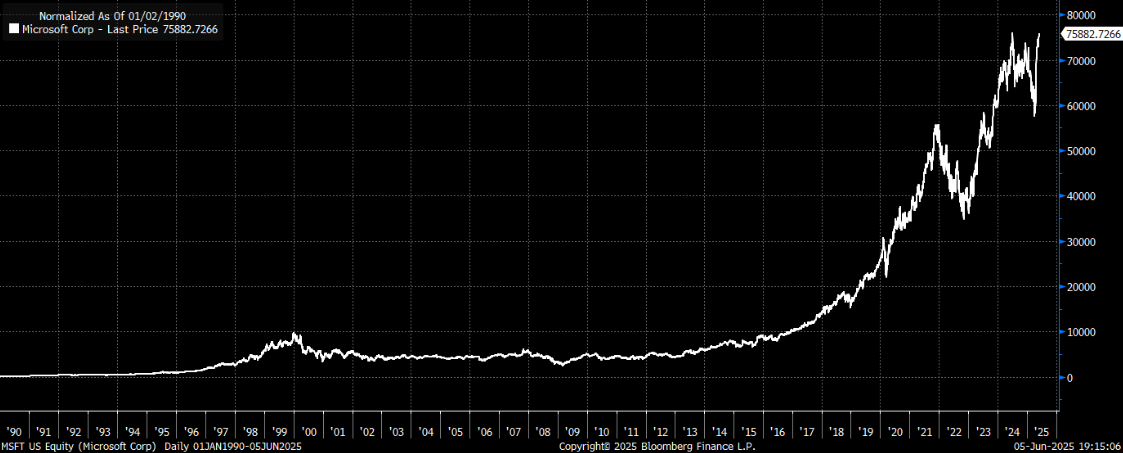
Now, thankfully, you don’t need a time machine to see gains like that in your portfolio…
Because we could very well be at that same kind of inflection point today with a new technological juggernaut: quantum computing.
You might think you’ve missed the boat because quantum stocks like IonQ (IONQ) have soared – and they have. But think again.
Here’s why the runway ahead could make today’s price chart surges look like mere blips…
What Is Quantum Computing?
Today’s traditional computers are built on top of the laws of classical mechanics.
They use what are called bits, which store data binarily as either “1” or “0.”
But quantum computers are based on quantum mechanics and use qubits, short for quantum bits, which can represent multiple states simultaneously thanks to principles like superpositioning and entanglement. (Think: “1” and “0” all at once.)
In plain English? They can process complex problems exponentially faster than classical machines.
This is like going from relying on candlelight to having access to a modern-day electrical grid.
The kinds of problems quantum computers will solve are fundamentally unsolvable by even the most powerful supercomputers today. We’re talking:
- Simulating molecules to discover new drugs: Pharma companies like Moderna (MRNA) and Boehringer Ingelheim are already experimenting with mRNA folding and enzyme simulation using advanced computational techniques, including AI and quantum computing.
- Revolutionizing battery chemistry and materials science: Microsoft’s Azure Quantum helped screen 32 million materials to identify a better battery chemistry candidate thanks to AI/quantum/high-performance-computing hybrids.
- Cracking ultra-secure encryption or building new forms of cybersecurity: Companies like Quantinuum developing Quantum Origin, a quantum-certified random-key generator, point toward a future of quantum-enhanced security.
- Turbocharging AI through hybrid quantum models: Quantum computers are built to handle incredibly complex data, making them a good fit for speeding up certain types of AI and machine-learning tasks that are too computationally tough for traditional computers.
- Solving optimization problems in logistics, finance, and climate modeling: Quantum computers can tackle really tough problems – like figuring out the best route or schedule – much faster than traditional computers because of special techniques like quantum annealing and Quantum Approximate Optimization Algorithm (QAOA).
A Shorter Runway to Mainstream Than You Think
Skeptics love to say quantum is “decades away.” But the history of tech adoption shows that timeline is collapsing:
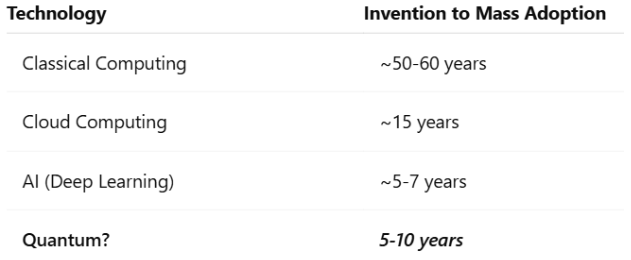
You’ll notice that adoption curves are getting faster for new technologies.
Classic S-curve diffusion models used to stretch across decades. See: electricity (~60 years) or automobiles (~30 to 40 years).
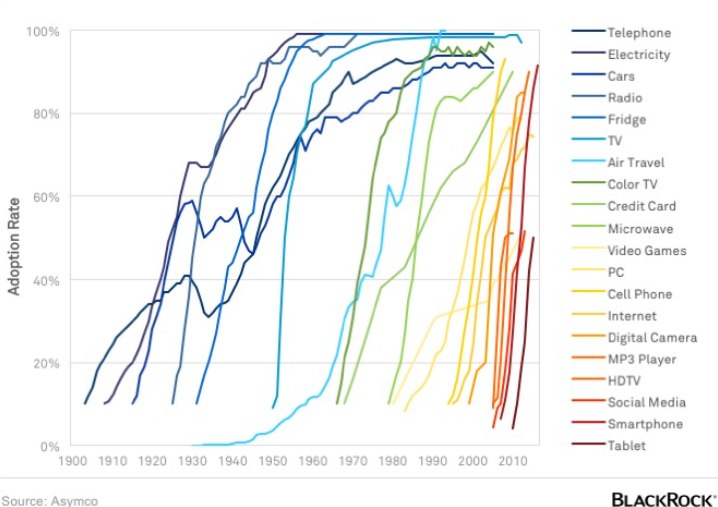
But modern innovations like smartphones, social media, and AI have hit the steep part of the curve much sooner, reaching mass adoption in just a few years.
And by this logic, it seems likely that quantum computers may only take five to 10 years to go mainstream.
That’s why we’ve already entered what some like to call the “hybrid quantum” phase, where companies like Microsoft, D-Wave Quantum (QBTS), and IBM (IBM) are integrating quantum systems into classical infrastructure.
As we mentioned, Microsoft’s Azure Quantum is already running scientific workloads in fields like chemistry, optimization, and materials design, partnering with companies and researchers to solve real-world problems. Meanwhile, cities like Chicago, Boston, and Chattanooga are developing quantum innovation hubs that combine academic research, startups, and public investment to position themselves as leaders in the coming quantum economy.
Quantum doesn’t need to replace classical systems. It complements them. That means adoption will likely be faster and smoother – especially now that the world is digitally mature and enterprises are comfortable deploying advanced tech thanks to the ongoing AI boom.
Parallel to the Titans: Classical & Cloud
To understand where we’re headed, it helps to see where we’ve been:
- Classical Computing – It took decades to scale. IBM ruled the mainframe era. Then came Intel (INTC) and Microsoft, who defined the personal computing revolution. Those who invested early and held through the volatility made life-changing returns as computing became ubiquitous.
- Cloud Computing – When Amazon Web Services launched in 2006, few understood the opportunity. But by 2020, cloud was the backbone of the digital economy. Microsoft, Amazon, and Alphabet (GOOGL) became dominant providers. And the infrastructure enablers – like Nvidia (GPUs), Arista (ANET) (networking), and Datadog (DDOG) (observability) – quietly captured massive upside.
- Quantum Computing – Right now, it’s like 2006 all over again. The foundational tools exist. Infrastructure is being built. Real-world use cases are starting to surface in areas like drug discovery, logistics, and materials science. But most people still don’t understand its potential. The winners are not yet obvious… but they’re already being shaped.
The lesson here? Tech transformations start slowly, then explode. And the market rewards investors who move before the mainstream catches on.
Quantum Computing Stocks Are Far From Topping Out
Yes, names like IonQ (IONQ), Rigetti (RGTI), and D-Wave have rallied big-time…
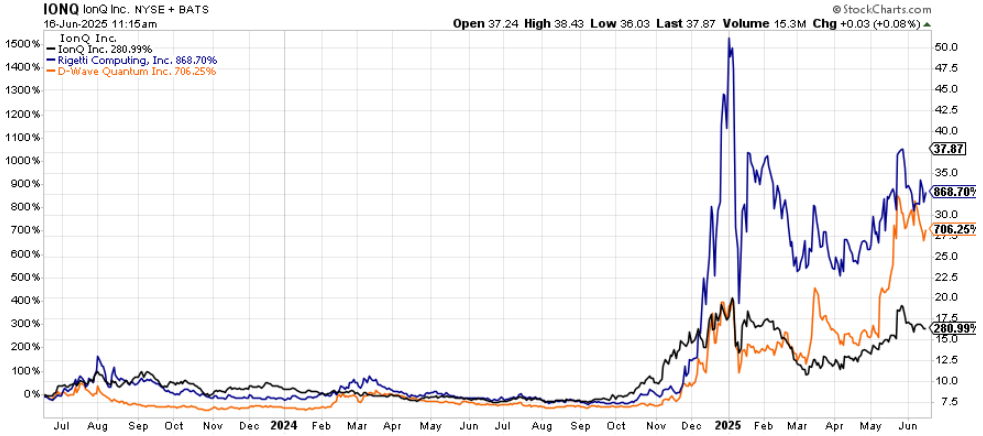
But these are still tiny companies.
IonQ is the biggest pure-play quantum computing firm. And it still only has a $10 billion market cap. D-Wave is the second-largest at $5 billion. Rigetti is ringing in at $3.5 billion.
Combined, the top three quantum stocks are worth less than $20 billion – and less than the R&D budget of Apple or Microsoft. They are miniscule relative to the scale of what they’re building.
By comparison:
- Nvidia is worth nearly $3.5 trillion
- Cowen and Bloomberg similarly value AWS in the $1.5- to $2 trillion range.
- Microsoft’s Azure stack is likely worth even more as Goldman Sachs projects Azure could reach $300B in revenue by 2029
If quantum computing reaches even a fraction of cloud’s scale, these early players could see 10x, 30x, even 100x returns from here. So, no – these stocks have not run away from you.
If they succeed in the long term, they still have massive potential.
‘The Toothpaste Is Out of the Tube’
Right now, we are in what historians will later call quantum computing’s ‘founding era’ – the phase when winners are made… when it feels ‘too early’ to investors until suddenly, it’s too late.
Key signals of exponential acceleration are flashing:
- AI and cloud infrastructure are paving the path for seamless integration
- Use cases in pharma, materials, and cybersecurity are moving from lab to enterprise
- Major players like Microsoft, Amazon, Google, and IBM are going all-in
And importantly, governments are pouring billions into national quantum programs. In the U.S., the National Quantum Initiative (NQI) has authorized over $1.275 billion for quantum research and development across agencies like the Department of Energy (DOE), National Science Foundation (NSF), and National Institute of Standards and Technology (NIST).
Folks, we are not waiting for quantum to ‘arrive.’ It’s already being deployed.
The toothpaste is out of the tube.
Final Word: Act Before the Quantum Computing Flashpoint
The opportunity in quantum computing is not in chasing a fad. It’s in recognizing a shift—one that is just beginning to reshape the global economy.
Classical computing birthed trillion-dollar empires. Cloud computing accelerated them. Quantum computing will redefine them.
And today’s sub-$10B quantum leaders could be tomorrow’s trillion-dollar titans.
Smart investors aren’t waiting for perfection. They’re preparing now.
Because when the quantum flashpoint hits—when one breakthrough app hits mass scale—the window will close. The curve will go vertical.
And those already on board will ride the arc of a generation-defining tech wave.
Quantum computing will likely mean huge breakthroughs for AI and robotics, too – because it could massively accelerate the compute time needed to power things like humanoid robots.
That means quantum could help pave the way for the Robotic Revolution – and potentially one of the largest shake-ups the labor market has ever experienced.
That has huge investment implications.
And one particular supplier stock seems to have outsized potential.