

Inside the AI Advantage: Where the Real Gains Are Coming Next
In boardrooms across the country – across the world, even – a massive divide is forming.
On one side are the companies rebuilding themselves from the ground up to fully integrate AI into their businesses. On the other? Those that are merely experimenting with this breakthrough tech: tacking on a chatbot here, dabbling in automation there, but making no real structural change.
The difference isn’t subtle. The early movers are quickly pulling ahead – boosting productivity, expanding margins, and capturing market share. Their earnings prove it. Their stock charts reflect it.
Yet, the laggards are falling further behind by the quarter…
And the longer companies wait to adapt, the harder it will be to catch up.
What happens next could define the next decade of market leadership – and reveal where some of the biggest AI gains are really hiding.
The Leaders in AI Are Surging
To see how far ahead the leaders already are, you don’t have to look far.
Salesforce (CRM) CEO Marc Benioff recently said that AI is already doing 30% to 50% of the work inside the company.
Clearly, this is a firm that has restructured itself around AI. And other tech giants have done the same.
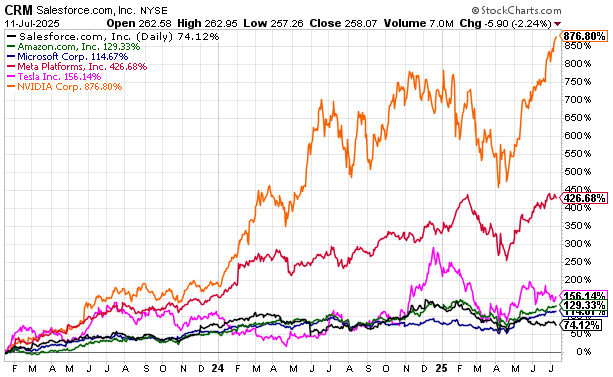
Microsoft (MSFT), Meta (META), Amazon (AMZN), Tesla (TSLA), Nvidia (NVDA) – all are embedding AI deep into every layer of their businesses.
Microsoft built Azure into a foundational platform powering AI for enterprise clients.
Meta integrated AI in business-facing tools, like conversational ads and support agents on WhatsApp and Messenger.
Amazon now has its own shopping assistant (Rufus), generative‑AI merchant adverts, and the AWS Bedrock LLM platform – all embedded end to end.
Tesla is equipping vehicles with its in‑house AI supercomputer, Dojo, with its Optimus robot meant to become its core growth driver.
Nvidia launched its own open-source multimodal LLM, NVLM 1.0, and its chips are pre‑sold through 2025.
These are all vastly different businesses, with one key similarity: AI is giving each strong operational advantages.
Just look at their stocks.
The Laggards Are Falling Behind
Meanwhile, the vast majority of small- and mid-sized companies – especially in non-tech sectors like construction, insurance, food service, retail, and logistics – are only scratching the surface with AI.
They might be dabbling with ChatGPT for marketing copy or experimenting with a chatbot on their website. But full-scale, enterprise-grade AI transformation? Not even close.
And their stocks, best encapsulated by the Russell 2000, have been lagging way behind Big Tech.
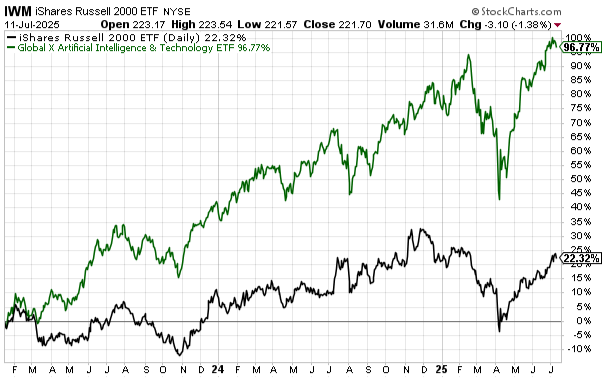
This market dichotomy isn’t just about some productivity gap.
It highlights an extinction-level threat for the AI laggards.
And we see an opportunity emerging as a result…
Because the same pattern played out during the rise of the internet.
Back then, Amazon, Netflix (NFLX), and Alphabet (GOOGL) moved early to rebuild their entire DNA around digital infrastructure.
Most others waited, debated, and underestimated. And when they finally realized what was happening, it was too late.
Retailers couldn’t catch up to Amazon’s logistical prowess. Blockbuster couldn’t keep up with Netflix’s streaming. Media companies couldn’t outrank Google.
Now we’re seeing the same story unfold with AI.
Big Tech is already ahead of the curve. But the rest of the business world is about to wake up to a terrifying reality: they can’t compete without AI.
And that’s when The Great AI Catch-Up begins.
The Great AI Catch-Up Could Spark the Market’s Next Growth Cycle
Here’s the investment angle most people are missing:
Over the next few years, the biggest growth in AI won’t come from Nvidia or OpenAI. It will come from the wave of businesses scrambling to adopt AI solutions to avoid being left behind.
These companies aren’t going to hire armies of data scientists to build their own LLMs. Instead, they’ll buy enterprise AI software that helps them survive in this new era.
This will create huge, durable demand tailwinds for AI vendors across the board – especially those focused on specific verticals.
That’s where the big investment opportunity lies.
These Enterprise AI Stocks Could Lead the Way
Here are some of the companies we believe are best positioned to ride this tidal wave:
- Palantir (PLTR): its Gotham and Foundry platforms leverage AI/ML to integrate massive, complex data sources into decision-making. For example, the U.S. Army uses Gotham to run ML-powered predictive analytics for logistics and mission planning, while BP uses Foundry’s AI-driven “Rate My Rigs” tool to forecast equipment failure.
- ServiceNow (NOW): NOW’s AI Engine powers Copilots for IT, HR, and customer service management. It’s used by firms like SiriusXM, which has IT Copilot automatically categorize and route IT tickets using NLP, cutting resolution time by 30%.
- Toast (TOST): Toast’s Restaurant AI Suite integrates ML across the board – AI-driven menu engineering that analyzes local sales and supply costs to reorder suggestions; its Labor Optimization tool, which uses real-time demand forecasting to reduce scheduling errors by 15%, and AI-powered chatbots for online ordering.
- Guidewire (GWRE): integrates AI into insurance workflows through its “Predict” product suite, which uses machine learning to assist insurers with risk scoring and claim triage.
- Samsara (IOT): the AI-enabled IoT platform analyzes sensor data to provide predictive alerts – like engine faults, braking anomalies, and idling trends – for fleets, distribution, and field services.
- Cloudflare (NET) and Twilio (TWLO): power the AI-era software stack behind the scenes. Cloudflare enables AI at the edge, optimizing content delivery and blocking threats with tools like Magic Transit and AI Workers. Twilio brings intelligence to customer communication, with messaging AI and virtual agents that automate millions of daily interactions across SMS, chat, and voice.
And that’s just the beginning.
We have a list of over 15 AI enterprise software enablers we’re watching right now – all of which we think will be big-time stock winners over the next few years as the Great AI Catch-Up goes mainstream.
Late Movers Are Waking Up: This AI Expansion Is Just Getting Started
What we’re talking about isn’t a slow-moving secular trend.
It’s a boardroom emergency. Companies are losing customers, margins, and talent to AI-powered competitors. They can’t afford to wait.
In fact, we’re already seeing a shift. According to McKinsey, AI adoption in at least one business function has jumped from 20% in 2017 to more than 75% today.
That number will likely keep surging into 2026. And as it does, the vendors enabling the catch-up will see exponential demand.
The AI Boom is not over, folks.
Instead, we believe it’s entering its next lucrative chapter.
Think about it. The internet, smartphone, and cloud all helped create trillion-dollar winners.
AI will, too; but it won’t just be the chipmakers and the headline-grabbers.
It will be the quiet enterprise software companies selling the tools to help every other business survive.
That’s where we’re placing our bets right now.
And if you want access to the names we’re recommending – and consistent updates on the Great AI Catch-Up trend – you can get it by subscribing to our Innovation Investor research service today.
We focus on the technologies that stand to reshape our futures – and hopefully mint fortunes along the way – like the Robotics Revolution that’s priming for takeoff…
Because history tells us that those who move early in a platform shift don’t just win. They dominate.
Get in while that window is still open.