

Anthropic’s Claude Mythos Leak Is Bigger Than You Think
A next-gen model, rising cyber risks, and a widening gap between AI winners and losers
The Iran War has been the loudest story in the room for weeks, for good reason.
Missiles, sanctions, proxy conflicts, oil spikes – it’s consuming every headline, every conversation, and frankly, a lot of investor headspace.
But at the same time, loud stories like these have a way of drowning out the ones that are quietly reshaping everything else.
Last week, for example, while most of the financial media was fixated on the latest developments out of the Persian Gulf, Anthropic accidentally leaked one of the biggest bombshells in recent tech history…
A configuration error in its content management system left a trove of internal documents – draft blog posts, internal memos, PDFs – sitting in a publicly searchable data store with zero authentication requirements. And tucked inside those files was a draft describing a model called Claude Mythos – a next-generation AI system that Anthropic’s own internal documents describe as the most powerful model the company has ever built.
When a security researcher stumbled across this revelation and the documents began spreading across forums and social media, Anthropic had a choice: deny, confirm, or say nothing. To its credit, the company confirmed.
“We’re developing a general purpose model with meaningful advances in reasoning, coding, and cybersecurity,” an Anthropic spokesperson told Fortune. “We consider this model a step change and the most capable we’ve built to date.”
What those documents reveal goes well beyond a product announcement – and the investment implications extend across nearly every corner of the AI trade.
Inside the Claude Mythos Leak: A New Tier of AI
Mythos – internally codenamed Capybara – is an entirely new tier of model, above Opus.
The leaked documents describe it as “larger and more intelligent than our Opus models – which were, until now, our most powerful.”
According to these files, Mythos delivers dramatically higher scores across coding and reasoning benchmarks. Claude Opus 4.6 already leads the industry, achieving 76.8% on the SWE-bench Verified leadboard.
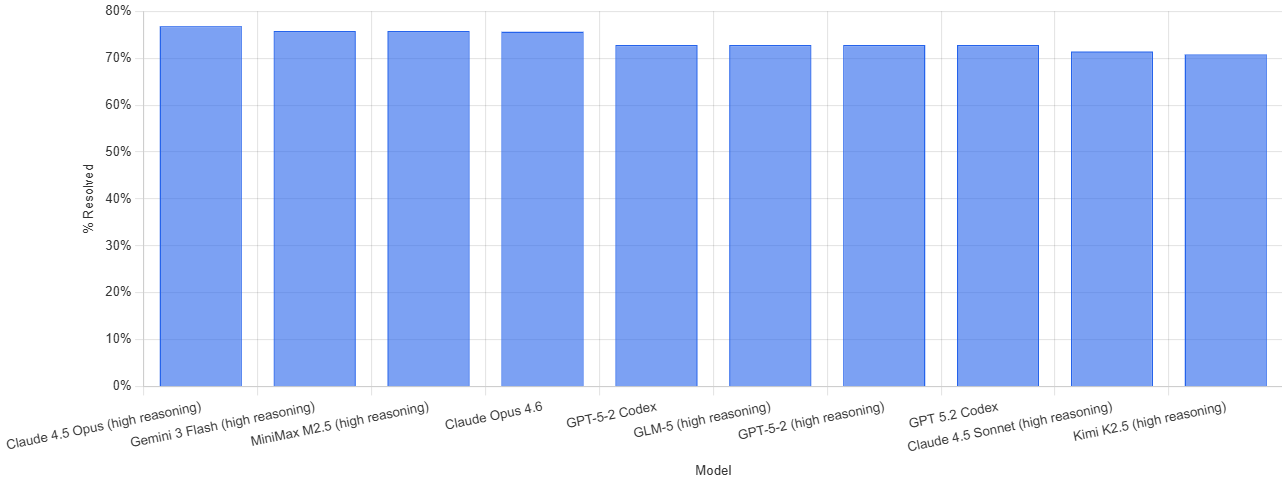
Even a slight improvement would put Mythos in territory no model has ever reached.
The angle moving markets is one thing. What’s rattling the government is another.
Anthropic’s internal documents describe Mythos as farther ahead of any other AI model in cyber capabilities – so much so that it will be able to exploit vulnerabilities in ways that far outpace the efforts of defenders.
In fact, Anthropic is so alarmed by this that they are privately briefing top U.S. officials, warning that Mythos makes large-scale cyberattacks much more likely in 2026 and beyond.
That’s a company scared of its own creation.
Mythos is not yet available to the public. Anthropic is currently testing it with a small group of enterprise customers, and the model remains too compute-intensive for general release – efficiency work is required before that becomes economically viable. Prediction markets put the odds of a public launch at roughly 73% by June 2026.
When it does ship, the two investment implications below will only sharpen.
AI Is Entering the ‘Lift-Off Phase’ (And It’s Accelerating Fast)
For the better part of three years, AI model development has been on an exponential improvement trajectory. But for most of that time, the curve felt gradual enough that you could still debate this tech boom’s impact.
ChatGPT, Claude, and Gemini were all impressive. But were they genuinely transformative? Were they actually changing how businesses operated at scale?
The answer over the past 12 months has shifted decisively from “maybe” to “definitely.” Over the past six months specifically, the pace of improvement has entered what we’d call the lift-off phase: the part of the exponential curve where the slope goes nearly vertical.
Consider what’s happened just since last year.
Claude Opus went from strong-but-contested to undisputed coding leader as measured by SWE-bench.
Gemini 3.1 Pro more than doubled its predecessor’s score on ARC-AGI-2 – a benchmark that tests a model’s ability to solve novel, pattern-based problems with minimal prior examples – rising from about 31% to roughly 77%.
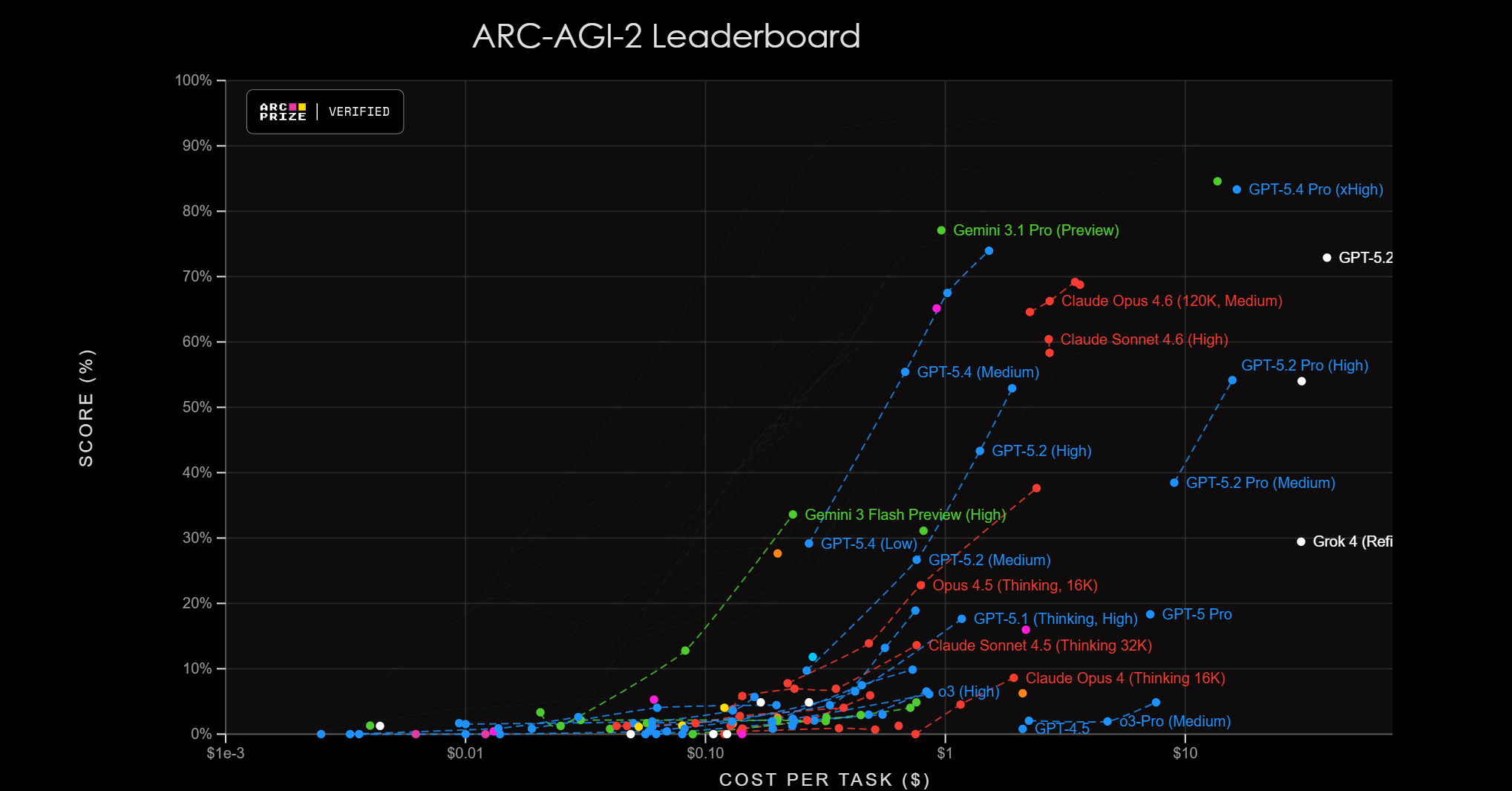
GPT-5.4 marked a real inflection point in agentic execution – demonstrating the ability to plan and complete multi-step tasks end-to-end, and operate software directly.
And now Mythos enters, claiming yet another full generational leap above the current best.
This is compounding progress. And compounding, as any investor knows, is where things get interesting.
The AI Arms Race Is Driving $600 Billion In Infrastructure Spending
The hyperscalers see it, too, which is why they’re keeping their feet on the gas. The top five – Amazon (AMZN), Microsoft (MSFT), Alphabet (GOOGL), Meta (META), and Oracle (ORCL) – are projected to spend over $600 billion on AI infrastructure in 2026, up 36% year-over-year.
These titans collectively generate hundreds of billions in free cash flow and are now spending faster than they earn it, financing the gap with debt.
That is the behavior of companies who believe they are in a race they cannot afford to stumble in.
Goldman Sachs (GS) estimates that AI capex has so far reached only about 0.8% of GDP, compared to peaks of 1.5% or higher during prior technology booms. There is a credible case that we are not even halfway through this infrastructure buildout.
Claude Mythos is the confirmation that all this spending is working; that the models are getting better at a rate that justifies, and will continue to justify, extraordinary capital deployment.
And that confirmation has exactly two investment implications – one very bullish, one very bearish.
The Biggest Winners of the Mythos Era
If models are getting exponentially better, better models require exponentially more compute to train and run, and the hyperscalers are locked in a capability arms race, then AI infrastructure spending is only going to compound.
Every new model generation forces a re-architecture of data center infrastructure – more GPUs, better networking, more memory bandwidth, more power, more cooling. Mythos being described as extremely compute-intensive is indicative of what’s to come. And it means the capex cycle continues.
Here are the stocks that sit most directly in the path of this spending wave:
Stocks to Buy
- Nvidia (NVDA) – Hyperscalers are building chip backlogs reportedly in the hundreds of billions for Nvidia’s next-generation Rubin architecture. If Mythos-class training runs require dramatically more compute, that backlog only grows. No intermediary, no ambiguity, no better seat at this table.
- Broadcom (AVGO) – Every GPU cluster needs interconnects and switches to function, and Broadcom supplies them. The major hyperscaler custom chip programs – Google’s TPU, Meta’s MTIA, Amazon’s Trainium – all run through Broadcom’s ecosystem.
- Taiwan Semiconductor (TSM) – Nvidia, AMD, Broadcom, and Micron all outsource production to TSM. It doesn’t matter which chip architecture wins the model wars. As long as frontier AI requires cutting-edge silicon, TSM makes it. Possibly the safest way to own the entire AI capex cycle without picking a chip winner.
- Arista Networks (ANET) – As GPU clusters scale to tens of thousands of chips for Mythos-scale training runs, the networking spend scales proportionally. Arista dominates 400G/800G switching – a category growing in lockstep with cluster size.
- Vertiv (VRT) – Compute density and heat output are rising, and Vertiv is the market leader in the cooling and power infrastructure required to keep it all running.
- Micron (MU) – Memory demand is a direct function of model size. Mythos being dramatically larger than Opus means more HBM per GPU, more NAND for inference caching, more memory everywhere. Also a recovery story – the recent AI memory selloff was overdone (a thesis we’ve covered in depth separately), and a new model generation accelerates the reversal.
- CoreWeave (CRWV) – When Anthropic needs to serve Mythos at scale before internal economics are workable, it rents CoreWeave. It is the most direct inference infrastructure play on frontier model deployment.
AI vs SaaS: Why Software Stocks Face Structural Decline
This is the part of the story that Wall Street is still wrestling with. And that’s costing investors money.
The SaaSpocalypse – a term to describe the roughly $2 trillion wipeout in enterprise software stocks that began in early February 2026 – was not irrational panic. It was the market correctly processing a structural truth: if AI models can perform the tasks that enterprise software enables, the per-seat licensing model that built the SaaS industry is fundamentally broken.
That is, if 10 AI agents can do the work of 100 sales representatives, you don’t need 100 Salesforce seats anymore. You need 10. That is a 90% reduction in seat revenue for the same economic output. And it doesn’t matter how entrenched the software is or how many years the enterprise has been on the platform – because the AI agent doesn’t need the software to complete the work.
Mythos accelerates this timeline dramatically. A model delivering dramatically higher capabilities in reasoning, coding, and autonomous task execution is more than just a better chatbot. It is an agent that can replace knowledge workers across entire departments. And when the knowledge workers go away, their software seats go with them.
Here are the stocks most directly in the crosshairs:
Stocks to Sell
- HubSpot (HUBS) – SMB-focused CRM and marketing automation = the category where AI agents displace humans most directly and switching costs are lowest. No meaningful data moat, premium multiple. And SMB customers are the fastest to cut seats the moment AI gives them a cheaper alternative.
- Atlassian (TEAM) – Jira, Confluence, and Trello are the canonical “AI will automate this” products. Task tracking, status updates, and documentation workflows are mechanical processes that AI agents handle natively. TEAM is already down 35% in the SaaSpocalypse, and the thesis has not changed.
- ZoomInfo (ZI) – ZoomInfo sells sales intelligence – prospect research, contact data, intent signals. That is precisely what an AI agent with web access does autonomously, continuously, and, increasingly, better. The disruption vector here is the most direct of any software name.
- Adobe (ADBE) – The creative suite under structural pressure from AI-native generation. If you can produce professional creative assets with a prompt, the case for a $600-per-year Creative Cloud subscription weakens materially. Firefly integration is a speed bump, not a moat.
- Workday (WDAY) – HR and finance workflow automation with per-employee pricing. As enterprises reduce headcount through AI automation, Workday’s revenue shrinks. The risk isn’t that AI replaces Workday; it’s that AI reduces the headcount that uses it.
- Datadog (DDOG) – As AI-native development tools handle monitoring and observability natively within agentic workflows, the need for a standalone observability layer compresses. Host-based pricing means revenue erodes with infrastructure abstraction.
- MongoDB (MDB) – AI coding tools weaken database lock-in by removing the expertise barrier that historically kept developers in a single architecture. A Mythos-class model that writes and optimizes database code at superhuman levels makes switching costs evaporate.
The Claude Mythos Leak Confirms the AI Investment Playbook
Let’s zoom out past the headlines for a moment.
The Iran War is serious. The macro headwinds from elevated rates and lingering uncertainty deserve attention.
We’re not looking past any of that. But consider what else is happening at the same time:
The most sophisticated AI research lab in the world just accidentally revealed that they’ve built a model so powerful they are afraid to release it publicly. They are privately briefing government officials about its implications. They have defined an entirely new tier of AI capability above their current best. And the hyperscalers — who have direct visibility into the ROI of these systems — are spending $600 billion this year, up 36% year-over-year, to build the infrastructure that trains and runs them.
That is a technology in lift-off.
In a situation like that, the investment playbook is clear: you bet on two things simultaneously.
- That AI will keep getting better. That means owning the companies that build the compute infrastructure – the chips, the networking, the power, the cooling – that trains the next Mythos, and every one thereafter.
- That AI will keep getting more disruptive. That means avoiding – or actively shorting – the software companies whose revenue models depend on human workers doing tasks that AI agents are increasingly doing better, faster, and cheaper.
These two bets are two sides of the same thesis. And Claude Mythos, accidental reveal and all, just made that thesis a lot more compelling.
The Bottom Line
Eventually, even the Iran War will end. The exponential improvement in foundational AI models will not.
The companies building the infrastructure that trains Mythos – and every model that follows – are the obvious first-order bet. But the second-order bet may be even more compelling: owning a piece of the AI platform that sits on top of all of it.
OpenAI is the company that forced every hyperscaler to restructure their roadmaps. It’s the platform that turned AI from a research curiosity into a $600 billion annual infrastructure commitment. And if the trajectory that Mythos confirms continues, OpenAI’s next chapter – as a public company – could be the defining investment event of this decade.
Most investors will wait for the IPO. We’ve found a way in before it happens, for under $10.
See the pre-IPO play before the window closes.