
How to Build a Portfolio for the New AI Capital Cycle
Over the past few days, I’ve been writing about what I call the “One Rule” economy.
In short: Washington has stopped refereeing the market and started directing it.
Through executive mandates, fast-tracked megaprojects, and federal supremacy over state regulators, the government has declared AI infrastructure a national security priority. That means data centers, semiconductor fabs, transmission lines, natural gas pipelines, and critical mineral supply chains are now being treated as nationally significant infrastructure – increasingly fast-tracked under federal authority instead of dying in a maze of local permitting battles.
America’s 250-year-old operating system – built on decentralized regulation and “invisible hands” – is being overwritten by a high-velocity Technological Republic.
And when the operating system changes, portfolio strategy must change with it…
Because in a regime shift, balance doesn’t win.
Alignment does. So, let’s get practical.
It’s time to build the “One Rule” Portfolio.
Step 1: Avoid Vulnerable Software and Labor-Heavy Stocks
Before you can build the future, you have to burn the past.
In the “One Rule” economy, some of the most beloved companies have become structural traps. These are the “Labor-Heavy” and “Knowledge-Toll” businesses.
Why SaaS Stocks Face Structural Pressure
If a company’s primary product is software sold on a per-seat basis to help boost human productivity, it is becoming increasingly vulnerable. Think of the Software-as-a-Service (SaaS) darlings of the last decade: Adobe (ADBE), DocuSign (DOCU), Salesforce (CRM), and Atlassian (TEAM).
In the old world, these were “sticky” businesses – stars throughout the 2010s.
But those former champions are getting crushed these days…
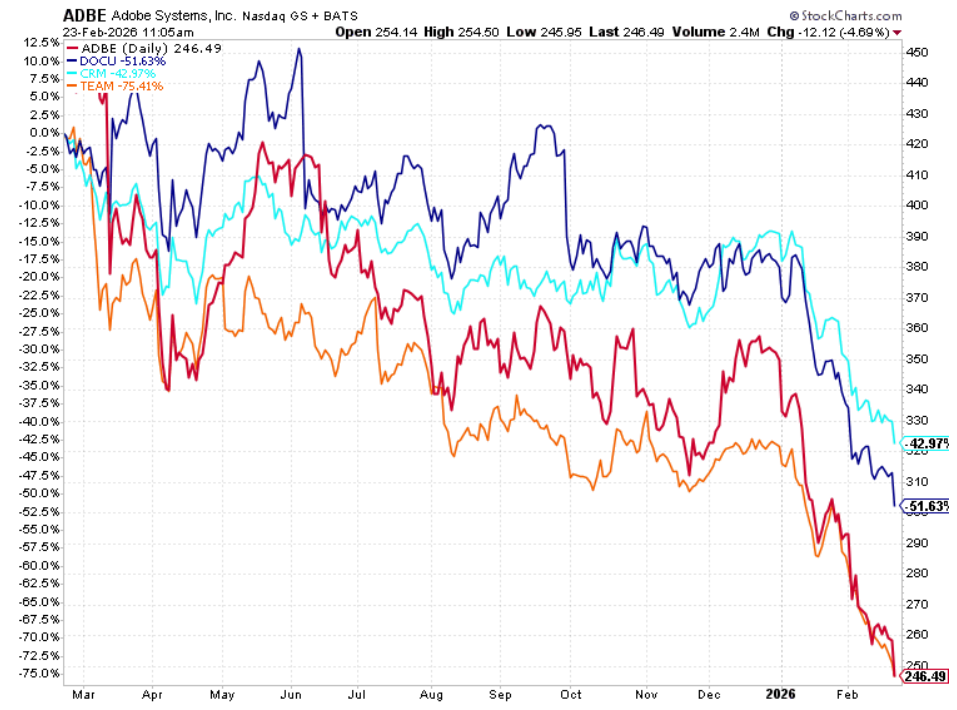
Seat growth is slowing. AI integration is squeezing margins. Multiples are compressing. Wall Street can see what’s coming – and it doesn’t like per-user pricing in an agent-based world.
Because in this new regime, AI isn’t just a feature they can bolt on. It threatens to replace the entire value proposition.
Why pay for a DocuSign subscription or an Adobe suite when an autonomous AI agent can draft, verify, and design everything within your private company firewall for much cheaper? These firms are now competing against models that deploy improvements in weeks – not quarters – and learn with every interaction.
And it’s not just software feeling the pressure.
Labor-Heavy Logistics Stocks Are Losing Momentum
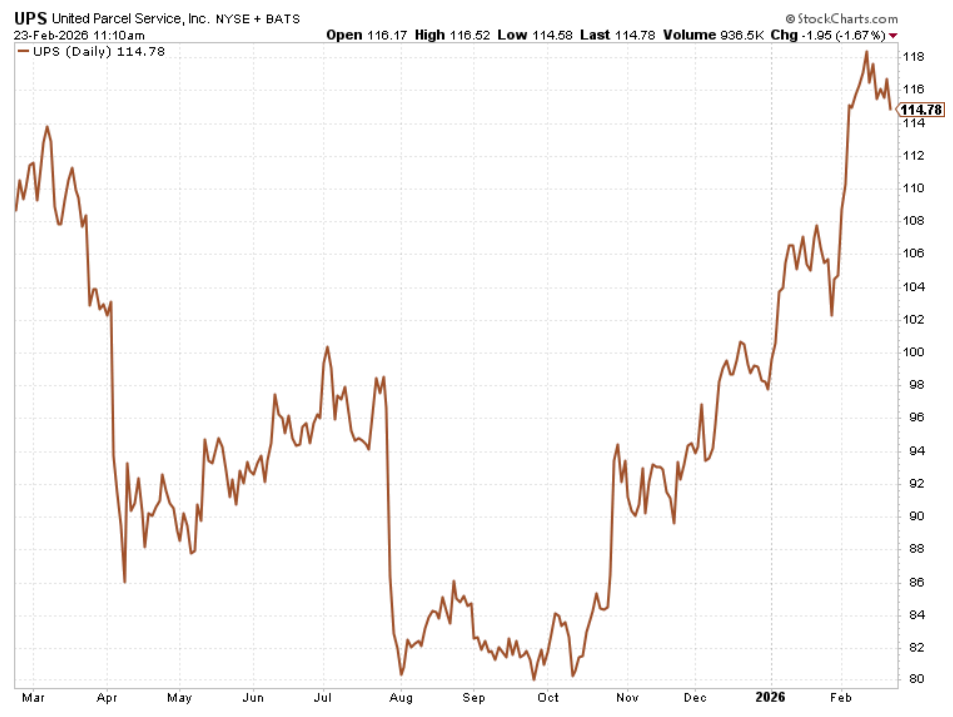
We are also nearing the end of the line for companies that rely on massive, expensive, human-centric logistics networks. I’m looking at you, UPS (UPS) and FedEx (FDX).
As the Technological Republic onshores manufacturing and uses AI to optimize local production (3D printing at scale, autonomous local delivery), the growth engine behind these massive, labor-heavy networks is starting to sputter.
They are capital-intensive dinosaurs in a world moving toward weightless intelligence. Global shipping volumes are normalizing post-pandemic, and automation investments are rising – compressing margins across the sector. And investors are starting to price that in.
We’re in a bull market. But UPS stock hasn’t gone anywhere over the past year.
Once you purge what’s vulnerable, the next step is obvious…
Step 2: Invest In AI Infrastructure Stocks
If you want to survive this “Great Decoupling” – where human cognition is no longer the primary value-driver – you have to own what AI cannot exist without: the Physical Layer.
You don’t want to own the app; you want to own the electricity, the silicon, and the land.
Natural Gas and Uranium: The Power Behind AI Data Centers
At its core, today’s “Intelligence Explosion” has a debilitating heat problem. A single complex AI query can use five to 10 times more electricity than a traditional cloud task. Scale that across billions of prompts, and you start to see the grid strain.
The “One Rule” economy has realized that wind and solar aren’t “Intelligence-Scale” power sources. While renewables will remain part of the mix, hyperscale AI infrastructure requires reliable, dispatchable baseload power – something natural gas and nuclear currently provide more consistently at scale.
This makes natural gas the “Bridge to the Singularity.” It’s the only dispatchable fuel the U.S. can scale quickly enough to keep up. So, even while the mainstream media warns about carbon footprints, the “Technological Republic” is fast-tracking natural gas pipelines and power plants.
- The Play: Look at companies like EQT Corporation (EQT) or Cheniere Energy (LNG). These aren’t “utility” stocks; they are “AI Infrastructure” stocks in disguise.
- The Nuclear Option: Alongside the sprint for natural gas, we are also seeing the return of uranium. The government’s move to revitalize the domestic nuclear supply chain (via its Genesis Mission) makes companies like Cameco (CCJ) essential “national security” assets.
Semiconductor Reshoring and the CHIPS Act Trade
The government has aggressively intervened in the chip supply chain.
Through the CHIPS and Science Act, Washington has already committed more than $50 billion to reshoring semiconductor manufacturing – reversing decades of offshoring in a single policy stroke.
And it hasn’t stopped at subsidies. The state has also picked its champions through direct investments and strategic partnerships.
- Intel (INTC): Intel isn’t just a struggling PC chipmaker anymore. It’s the only major U.S. logic manufacturer with real domestic fabrication capacity – and that makes it strategically indispensable.
- MP Materials (MP) and Lithium Americas (LAC): If you want to build high-performance magnets for data centers or batteries for autonomous systems, you need rare earths and lithium. Federal policy is now openly prioritizing domestic sourcing of these materials, turning miners into strategic assets.
The Window Is Closing
The federal government has made its choice. And markets are starting to notice.
It is accelerating energy buildouts, subsidizing domestic chip manufacturing, shielding strategic mineral supply chains.
It is not protecting SaaS seat counts or supporting labor-heavy middlemen.
That’s the signal.
The “One Rule” doesn’t need to announce itself every day. It shows up in permitting approvals, subsidy packages, and litigation shields.
If your portfolio aligns with those currents, you compound. If it fights them, you stall.
The Physical Layer is where policy, capital, and necessity converge.
That’s where you want exposure.
I recently put together a full briefing on how this new state-backed capital cycle works, why it’s accelerating under the banner of national security, and which layers of the AI stack are positioned to benefit first.
If you’re looking to build a “One Rule” portfolio, this is your blueprint.