
Tech Predictions 2026: The Year Software Crawls Into Physical Reality
Five long-brewing technology curves – humanoids, robotaxis, AI glasses, custom chips, and nuclear – are about to graduate from demo to deployment
Every year, the tech industry promises we’re about to “enter the future” – and then promptly disappoints. That future arrives as a slightly thinner phone, a slightly stronger GPU, a slightly more sophisticated wearable…
But 2026 looks different.
A handful of long-brewing technology curves – robotic embodiment, autonomy, ambient AI, custom silicon, and next-gen nuclear – are all hitting their first real-world validation phase at roughly the same time.
That’s when the conversation shifts from ‘cool demo’ to ‘wait… this is deployed?’
The question isn’t whether these technologies will arrive. The prototypes already work.
The question is whether 2026 becomes the year they escape the lab and enter the economy at scale.
Here are five predictions where I’m willing to put stakes in the ground – written with full awareness that the internet will screenshot this and dunk on me if a robot trips in a warehouse on January 3.
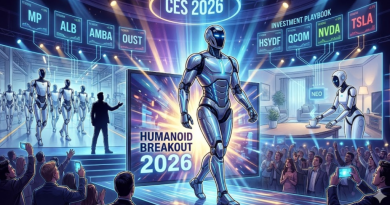
1. Humanoid Robots Clock In for Real Shifts in 2026
For the last decade, humanoid robots have been the technological equivalent of vaporware.
But I think that changes in 2026 – because the minimum viable product for humanoids is now obvious: do a small set of repetitive tasks in controlled environments, reliably, for long shifts, with measurable ROI.
We’re already seeing real industrial proof points that the ‘humanoid worker’ is graduating from concept to deployment.
Figure‘s November 2025 update on its BMW Spartanburg deployment details an 11-month program that progressed to active assembly-line work, with robots running 10-hour shifts Monday through Friday and contributing to the production of 30,000+ X3 vehicles.
Meanwhile, Agility Robotics‘ Digit is already moving through the pilot → paid deployment → multi-site expansion arc. Agility has demonstrated Digit’s commercial operations with GXO (a robots-as-a-service model) and has announced additional commercial agreements (like with Mercado Libre). And Amazon (AMZN) has been testing Digit for a while, focused on tote handling and item consolidation – repetitive tasks where Digit’s humanoid form makes it more advantageous than traditional wheeled robots in navigating human-designed spaces.
Next up? Homes.
Not to the extent that everyone will have a humanoid that folds the laundry, walks the dog, makes dinner, and mows the lawn. But 2026 is likely the year we’ll see true early consumer shipments (limited volume, supervised autonomy).
1X has announced that U.S. deliveries of its NEO home robot will start in 2026, with an Early Access ownership price point of $20,000. That may be more of a ‘rich early adopters as product testers’ wave than ‘mainstream consumer’ wave. But it’s still the first time the home humanoid story feels like an actual product and not a sci-fi storyboard.
Prediction: By the end of 2026, humanoids will be visibly present in real operations – factories and warehouses first, then early access in homes. They won’t be ubiquitous or perfect but real enough that “humanoids are coming” starts being a procurement question rather than a debate.
2. Robotaxis Scale to 20-Plus U.S. Metros
Robotaxis have been operational in the United States for several years now, ever since Waymo began offering public driverless rides in Phoenix back in 2020.
Today, the robotaxi footprint is still relatively small but expanding. Waymo offers rides in Phoenix, the San Francisco Bay Area, Los Angeles, Austin, and Atlanta. And Zoox opened a public robotaxi service in Las Vegas (alongside operations in San Francisco). Altogether, that’s about six major metro areas.
I expect that 2026 is when that city count starts to climb fast. And there are two ways to make it happen – one ambitious, one practical.
A) Ambitious
If you define a “robotaxi city” as paid, on-demand, driverless rides available broadly to the public, then getting to 20-plus by the end of 2026 is… ambitious. That takes fleet scale, mapping, remote ops, depots, local regulatory alignment, etc.
B) Practical
If you define “robotaxi city” the way most people would experience it – AV ride availability in a meaningful area, via a mainstream app, with expanding hours/coverage – then 20-plus metros is very plausible by late 2026.
Waymo has already announced it’s introducing fully autonomous operations in Miami, Dallas, Houston, San Antonio, and Orlando. That’s five incremental metros right there, plus its existing five.
Zoox is also signaling expansion beyond Las Vegas and San Francisco, including “coming soon” markets like Austin and Miami on its “where to ride” materials.
And then there’s the sleeper catalyst: Uber (UBER) as the robotaxi distribution layer. Uber’s CEO has said the company expects robotaxi services in more than 10 markets by the end of next year – meaning 2026 – via partnerships. Even though many of those launches will begin as limited geofenced areas, the city-count math starts compounding quickly.
Prediction: By the end of 2026, the U.S. will have 20-plus metros where consumers can order robotaxi/AV ride services – some fully driverless and scaled, many limited-but-real, most expanding quarter by quarter. The shift won’t be “national” in the literal sense. It will be “national” in the cultural sense, where everyone knows someone who’s ridden in a robotaxi.
3. AI Glasses Bring Ambient Intelligence Mainstream
2026 is when AI stops being something you pull out of your pocket and becomes something that’s simply present – ambient, always-on, hands-free, and aware of what you’re actually doing.
The only form to make that feel natural is wearables, especially glasses. And we’re lining up for a year where multiple platforms push real product timelines:
- Google + Warby Parker: Reuters reports the duo plans to launch AI-powered smart glasses in 2026, built around Android XR and Gemini, with variants that may be screen-free or include an in-lens display. The report also indicates these devices will leverage real-time translation, visual search, and navigation features, building on Google’s existing Glass Enterprise learnings.
- Apple (AAPL): Bloomberg reports Apple is planning smart glasses by the end of 2026, with suppliers beginning to mass-produce prototypes in late 2025. Apple’s approach reportedly focuses on seamless iPhone integration and all-day battery life, addressing the key pain points that limited earlier smart glasses adoption.
Now, none of this means that smartphones will vanish in 2026. But they likely will stop feeling like the center of our universe.
The first wave of AI wearables won’t replace phones the way iPhones replaced BlackBerrys. Instead, they’ll replace the most frequent phone behaviors:
- Quick questions
- Messaging shortcuts
- Navigation and reminders
- Translation and identification
- Capturing and summarizing real life (meetings, errands, etc.)
Once you have a wearable that can see what you see, hear what you hear, and help you in real time, the ‘pull out slab → unlock → type → search → scroll’ workflow starts to feel archaic.
Prediction: 2026 is the year AI wearables (especially glasses) hit enough product-market fit that they become an exciting tech category again, and early adopters genuinely start leaving their phones in their pockets for long stretches of the day.
4. Big Tech’s Custom Silicon Breaks Nvidia’s Lock
Nvidia‘s (NVDA) chip dominance over the past several years has been born of two moats: best-in-class GPUs and CUDA – the software ecosystem that makes those GPUs the default. CUDA’s decade-long head start has created an estimated $1 trillion in switching costs across the AI ecosystem, as developers, tools, and optimization pipelines are deeply CUDA-native.
But Big Tech is about to attack both at once.
On the hardware front, the direction is clear: hyperscalers want custom silicon to reduce cost, secure supply, and tailor chips to their workloads.
We’re now seeing credible reports of real ‘cross-pollination’ between Big Tech chip stacks:
- Meta (META) ↔ Google TPUs: Meta is in talks to spend billions on Google’s TPUs, potentially renting via Google Cloud as early as 2026, with larger-scale use discussed starting 2027.
- OpenAI ↔ Amazon Trainium: Amazon is in talks to invest in OpenAI, and the arrangement includes OpenAI using Amazon’s Trainium chips.
- Microsoft’s (MSFT) Maia: Mass production of Microsoft’s next-gen Maia chip was delayed into 2026, which highlights how hard this is – but also how committed hyperscalers are to doing it anyway.
Yet, the real plot twist is the software front.
Reuters just reported that Google is working on ‘TorchTPU‘ to make its TPUs run PyTorch more smoothly, with Meta’s help (Meta is the primary backer of PyTorch). The goal is to reduce switching friction away from Nvidia’s CUDA-centered world by making the dominant developer framework perform beautifully on non-Nvidia hardware. PyTorch commands roughly 60% of AI research frameworks (per Papers With Code), making CUDA-to-TPU portability critical for Google’s cloud chip ambitions.
That’s the tactical shot – because the way Nvidia loses share is when inference workloads migrate to cheaper custom chips, training becomes more heterogeneous across TPUs, Trainium, and GPUs, and the software stack gets more portable.
Then, suddenly, Nvidia is competing on price/performance like a normal company.
Prediction: In 2026, Nvidia will remain enormous, but the ‘default Nvidia’ assumption will break. Custom silicon becomes a real, visible, multi-platform ecosystem – and software portability initiatives like TorchTPU start shaving down CUDA’s switching-cost advantage. Nvidia’s monopoly doesn’t die; it gets unbundled.
5. Nuclear SMRs Hit Criticality: Proof Over Promises
Nuclear has been ‘back’ so many times, it should have a punch card.
But 2026 could be the first year we get a very specific kind of validation: multiple advanced reactor projects achieving first criticality.
The U.S. Department of Energy’s Reactor Pilot Program aims to reach criticality for at least three advanced reactor concepts outside national labs by July 4, 2026 – America’s 250th anniversary. The DOE pilot program has awarded approximately $900 million in funding across seven selected projects, including X-energy’s Xe-100, Kairos Power’s Hermes, and TerraPower’s Natrium demonstration.
Now, there’s an important nuance here: criticality is not the same as commercial grid power. But it is the moment the technology moves from design documents and PowerPoints to actual fission.
This matters because the market doesn’t need a hundred SMRs online to reassess the nuclear complex; just proof that the new wave of designs can hit milestones, in the real world, on something resembling a schedule.
Prediction: By late 2026, at least some of these pilot efforts achieve criticality, and we see a much clearer path for follow-on deployments. Even if the July 4 goal delivers one or two successes rather than the full cohort, it proves the technology works – and that’s what changes the conversation.
2026: The Year Tech Leaves the Screen
For all five of these predictions, there’s one major throughline: 2026 is when software starts crawling out of the screen and into physical reality.
- Robots that do work
- Cars that drive themselves
- Glasses that make AI ambient
- Chips that challenge incumbents
- Nuclear that powers this AI-driven transformation
And if 2026 really is the year these trends are validated, then 2027 is when the folks who got positioned early reap the rewards.
I’ve been tracking these five technology curves closely, and the pattern is clear: the companies that survive the validation phase – the ones that can actually ship humanoids that work, deploy robotaxis that scale, build chips that compete – become the next generation of platform companies.
The challenge is finding them before everyone else does. Once BMW announces Figure robots are running full production lines, Waymo hits 50 cities, or Meta’s custom chips are outperforming Nvidia on cost, the ‘early investor’ window is closed.
That’s why I put together a detailed video presentation on the startups positioned at the center of these trends. It covers:
- The specific AI startups that are poised to become the next Googles and Amazons.
- The “Network Effect” and how to spot it before Wall Street does.
- My “VC Insider” methodology – how I use my Caltech background and Silicon Valley contacts to find these deals before the general public.
Watch the full presentation here if you want to see which companies are actually positioned to win in 2026.