The Little-Known Chip Powering the Very Future of AI
As more AI shifts from the training to inference phase, TPUs are primed to steal the spotlight
Editor’s note: “The Little-Known Chip Powering the Very Future of AI” was previously published in June 2025 with the title, “How Google’s TPU Is Powering the Very Future of AI.” It has since been updated to include the most relevant information available.
For nearly three years now, Nvidia (NVDA) has seemingly had AI hardware locked up tighter than Fort Knox.
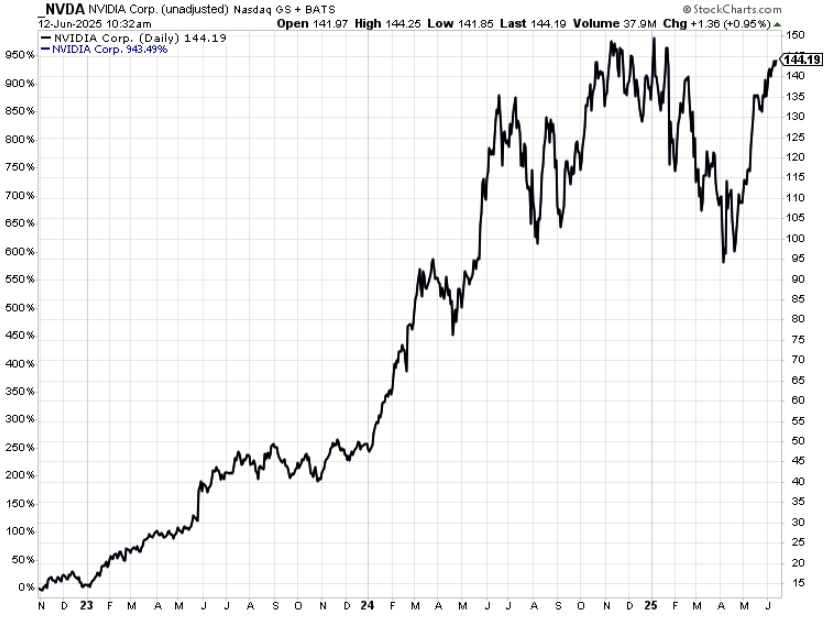
The company’s GPUs (Graphics Processing Units) have been used to train every headline-grabbing AI model, from ChatGPT to Gemini. And as a result, Nvidia stock has gone supernova, up nearly 950% since November ‘22.
For a while, it looked to own the keys to the entire AI kingdom.
But what if I told you there’s another chip quietly emerging from the shadows; one that OpenAI – one of the world’s most important AI companies – is starting to use instead?
It’s one that most investors haven’t yet heard of; and that Nvidia doesn’t specialize in…
A chip that, thanks to a seismic shift from Nvidia-dominated GPU training to inference and deployment at scale, could soon become the hottest chip on the market…
A Tensor Processing Unit, or TPU.
A TPU is a custom-built chip that Google designed specifically for running AI models.
Unlike Nvidia’s GPUs, which were originally built for rendering video game graphics and later repurposed for AI, TPUs were born with one job: execute computations at blistering speed and maximum efficiency.
In essence, you can think of GPUs as general-purpose race cars and TPUs as hyper-optimized rockets.
And while GPUs are best at training AI models, TPUs were made to dominate inferencing: the part where AI actually thinks, reasons, and responds to users in real time.
That’s where AI models are going – and why TPUs could start to steal the show in a big way.
TPUs Matter More Than Ever in the ‘Age of Inference’
In some ways, creating genius-level AI is a lot like raising a child.
You teach them everything they need to know, with books, flashcards, lectures, and thousands of examples. It takes time. It’s expensive. And for machines, it’s computationally brutal.
When they achieve inference, they can actually answer questions, solve problems, write custom pieces, or create unique visual art.
Historically, the AI race has been all about training; and Nvidia GPUs became the workhorses of that race.
But once the model is trained, inference is forever. The AI runs billions of times to serve billions of people.
That’s where the money – and the demand for computational power – starts compounding.
DeepSeek’s Inference Shift: A Breakthrough Moment
Remember the DeepSeek saga that unfolded earlier this year?
Back before the trade war started (which seems like forever ago, I know), a Chinese AI lab named DeepSeek dropped a bomb on the industry.
It had trained a GPT-4-class model for just $6 million… a fraction of the $100 million-plus price tags seen in Western AI labs. But that wasn’t the headline. The real innovation was architectural: DeepSeek built its model to do less thinking upfront and more thinking on the fly using inference.
In other words, instead of baking every answer into a gigantic model during training, it designed this system to reason dynamically in real time. That changed everything.
Suddenly, inference wasn’t just about reading a playbook. It became the playmaker.
And in that world, you want chips that are lean, fast, and optimized for inference. You want TPUs.
Why TPUs Could Be the Next Must-Have AI Chip
Google’s TPUs are already being used internally to power Search, Translate, YouTube, Ads, Gemini, and even Veo 3, its latest AI video model. They are:
- Blazing fast for inference: TPUs are specifically designed to accelerate the types of matrix math operations that underpin AI inference, especially for large language models (LLMs) and deep learning systems. Compared to general-purpose GPUs, they can deliver lower latency and higher throughput for inference workloads.
- Incredibly power-efficient: Because TPUs are custom-built for the specific demands of AI (rather than being retrofitted like GPUs), they avoid unnecessary overhead and can process more computations per watt. This efficiency is critical for running massive AI workloads sustainably – especially at Google’s scale – and powering energy-intensive services like Ads and Gemini with lower operational costs.
- Integrated directly into Google Cloud, allowing developers and enterprises to tap into the same hardware that powers the company’s flagship AI services – without needing to build their own data centers or rely on Nvidia GPUs. And in fact, Google isn’t stopping at the cloud. This year, it partnered with MediaTek to bring TPU-based AI processing directly into smartphones and consumer devices – a major leap that could make low-latency, on-device AI a mainstream reality. This signals a strategic push to embed TPU power into the physical world, not just server racks.
As more AI shifts from the training to inference phase, TPUs are primed to steal the spotlight.
They just need to win at scale in inference – where the real money lives.
That doesn’t mean that Nvidia is doomed as the world shifts from GPUs to TPUs. The titan still owns the training space. And its newer chips, like the Blackwell B200, are getting better at inference, too.
However… Nvidia’s once-iron grip is loosening. The AI hardware market is no longer a one-horse race.
And if the future is inference-heavy, then Google – and the companies involved in TPU production – stand to gain a lot.
Manufacturing the Future: Winners of the TPU Supply Chain
Let’s follow the money here.
Google designs TPUs. Obviously, that means that if TPUs do become the hottest AI chip in the market, GOOGL stock will soar.
But Google doesn’t build TPUs alone. There’s a whole supply chain of companies helping it bring TPUs to life.
We like GOOGL stock for the next few years as TPUs gain traction. But we might like those supply chain stocks even more.
Think Broadcom (AVGO). It’s been providing custom silicon to help Google make TPUs for years. If TPUs go viral, AVGO stock stands to gain.
Or how about Arm (ARM)? Google utilizes Arm-based CPUs in its data centers to complement its TPUs for AI workloads. Presumably, if TPU demand soars, demand for these complementary Arm-based CPUs will soar, too. And ARM stock could be a big winner.
Then there’s Taiwan Semiconductor (TSM), the world’s largest chipmaker. Essentially, it makes all the world’s AI chips. While specific details are scant, it is widely speculated that TSM also fabricates Google’s TPUs.
The TPU supply chain is quite long and complex. And if TPUs take over the hardware market as we expect, many stocks could be on the launching pad to generational gains.
Get Positioned for the TPU Boom
In 2023 and ‘24, most chased AI riches by working to train the smartest model.
But in 2025 and beyond, the market will realize that the real money is in running those models efficiently, everywhere, all the time.
And when that happens, TPUs could very well be the hottest chips on the block.
The AI gold rush isn’t over. It’s just entering its second chapter. And the biggest winners may be hiding in the TPU supply chain…
Of course, LLMs aren’t the only tech reliant on ultra-powerful TPUs.
We think that behind the scenes, these chips are quietly laying the foundation for something even more profound: humanoid robotics.
These machines will do more than just answer questions. They’ll have the power to physically act. Think warehouse robots that learn on the fly, medical assistants that adapt in real time, or domestic helpers that move, see, and reason like humans do.
None of this happens without fast, low-cost inference… and TPUs make that possible.
They could power an entirely new economy built on thinking machines.
And the companies building that backbone may be the biggest winners of all.