What You’re Not Being Told About the AI Economy
While the world celebrates AI innovation, economic power may be concentrating faster than ever
Editor’s note: “What You’re Not Being Told About the AI Economy” was previously published in March 2026 with the title, “The Hidden Wealth Transfer Inside the AI Revolution.” It has since been updated to include the most relevant information available.
In 1848, a carpenter named James Marshall spotted something glinting in the water at Sutter’s Mill in Coloma, California.
Within months, 300,000 people had flooded the state. They came with pickaxes, tin pans, and dreams of striking it rich.
Most went home broke.
The ones who got rich? They weren’t the miners. They were the merchants. The men who sold the shovels. The ones who understood, before the stampede began, exactly where the gold was really flowing.
Right now, a transfer of wealth is unfolding that could rival some of the largest shifts in modern economic history. And like 1848, most people are too distracted by the excitement of the rush to notice who’s actually pocketing the gold.
The financial press isn’t talking about it plainly. Neither are the politicians – many of whom are actively participating in it. Instead, the story gets dressed up in the comfortable language of innovation, disruption, and national competitiveness. It’s celebrated on earnings calls. Packaged as thrilling news about a technology that will make all of our lives better.
Maybe it will. Eventually.
But not before it makes a very small group of people generationally wealthier… while most others are left holding the pan.
Here’s what makes this moment different from the dot-com boom, different from the shale revolution, different from every previous technological disruption: the speed. According to a recent analysis, the last major platform shift took roughly a decade to fully restructure the economy. This one is moving in months.
That means the window for ordinary investors to position themselves on the right side of this transfer (before the mainstream catches on) is closing faster than most people realize.
What is happening has a name. And understanding it, right now, may be the single most important financial decision you make this decade.
In this issue, I’ll show you exactly what’s going on, why it’s moving so fast, and – most importantly – how you can position yourself among the few, not the many.
A Historical Parallel Worth Revisiting
In England, between the 16th and 18th centuries, the landowning class executed one of the most consequential wealth transfers in history. They called it enclosure.
The common lands that ordinary people had farmed and depended on for generations – the shared economic foundation of an agrarian society – were gradually privatized. Parliamentary acts were passed. Fences went up. Farmers and laborers who had worked the land for generations found themselves trespassing on what used to be theirs.
They didn’t disappear. They lost their independent economic footing and became dependent on the very people who had enclosed the land. And many became the labor force for the Industrial Revolution.
The enclosers didn’t think of themselves as villains. They were “rational actors” with good lawyers, political connections, and a compelling narrative about efficiency and progress. The fences, they argued, were actually better for everyone in the long run.
The pattern should sound familiar…
The ‘AI Enclosure’: How Artificial Intelligence Is Privatizing Cognitive Labor
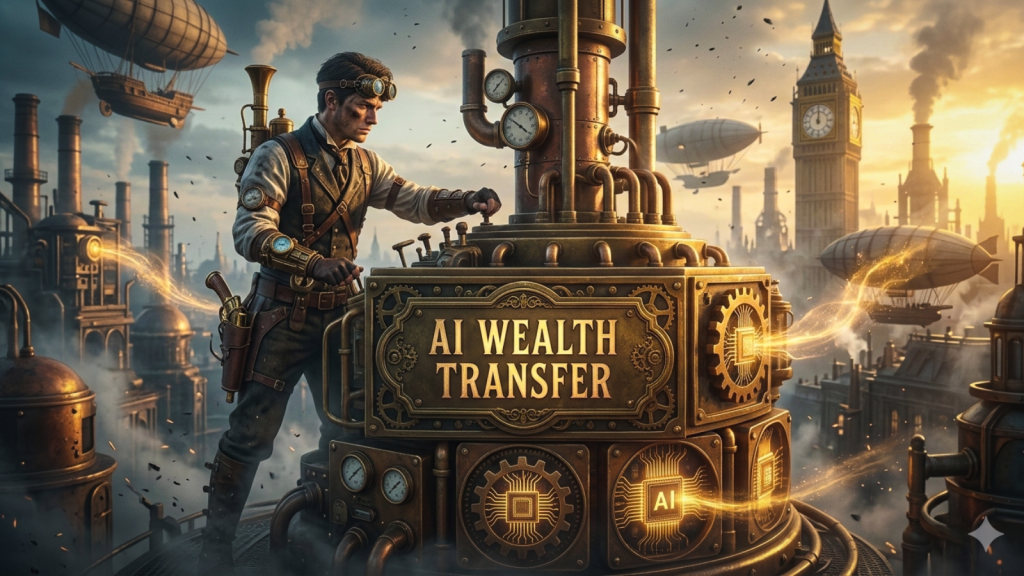
The “AI Enclosure” is the 21st-century version of this same story – and it is happening in real time, while most people are busy arguing over politics and worrying over their job security.
What is being enclosed this time is not land. It is intelligence itself.
For most of modern history, cognitive ability – the capacity to read, write, reason, analyze, build, create, persuade – has been widely distributed. You cultivated it through education and experience. It was yours. No one could take it from you. In an economy built on knowledge work, that endowment was your ticket to the middle class; your identity and security.
A small number of companies are beginning to concentrate control over that endowment.
They are encoding human intelligence into model weights, embedding it inside proprietary systems, and charging rent for access to a resource that used to belong to everyone who developed it.
The senior product manager, the paralegal, the financial analyst, the mid-level software engineer – these people spent years and borrowed money building cognitive skills they were told would always be valuable.
The fences are going up around those skills. And the people raising them are not asking for permission.
The Moment the AI Labor Shift Became Obvious
Most major structural shifts have a watershed moment, when the abstract becomes undeniable – when the thesis stops being a prediction and becomes a description.
We think we just had ours.
Last week, Block (XYZ) CEO Jack Dorsey announced that the company – the fintech conglomerate behind Square, Cash App, and Afterpay – would cut 4,000 employees, roughly 40% of the entire workforce. It was the largest single-round percentage layoff in the history of the S&P 500.
He didn’t frame it as a cost-cutting measure, blame the economy or the market, or claim it was the result of a strategic pivot gone sideways. He said, plainly, that “intelligence tools have changed what it means to build and run a company” – and that he’d rather get there honestly and on his own terms than be forced into it reactively.
In effect, Dorsey didn’t just fire 4,000 people. He fired the starting gun. He gave every CFO at PayPal (PYPL), Shopify (SHOP), Stripe, Adyen (ADYEY), and every financial services firm watching nervously from the sidelines what they needed most: cover. The moment one player in a competitive industry achieves structurally lower operating costs through AI-driven headcount reduction, the others face a binary choice: match the efficiency, or compete at a permanent cost disadvantage.
In a low-margin industry, there are few alternatives – which means the pressure to follow suit will spread quickly. So, fintech will cut. Broader financial services will follow. Then software, consulting, law, accounting… The logic that justified Block’s announcement applies to every industry where the primary input is human cognitive labor – where people are paid, essentially, to think.
That is the knowledge economy, which employs tens of millions of Americans today. And Dorsey just announced that its restructuring has begun.
The New Power Structure of the AI Economy
The AI Enclosure is not a hidden conspiracy. It is a visible, mutually reinforcing network of capital, technology, and political power that has converged with unusual speed and clarity around a single asset class.
The Hyperscalers: Owners of AI Compute Infrastructure
Microsoft (MSFT), Alphabet (GOOGL), Amazon (AMZN), Meta (META). They own the compute infrastructure – the data centers, cloud platforms, and distribution channels through which AI reaches the economy.
The Model Builders: The Companies Controlling AI Intelligence
OpenAI, Anthropic, xAI, Google DeepMind. They own the AI itself – the model weights that encode humanity’s accumulated knowledge and make it available to whoever can pay for access.
The Semiconductor Gatekeepers of the AI Economy
Nvidia (NVDA), Taiwan Semiconductor (TSM), Broadcom (AVGO). They manufacture the physical hardware on which all of this runs. Nvidia’s GPUs function almost like the oil wells of the AI economy.
The Capital Network Funding the AI Boom
Andreessen Horowitz, Sequoia, Founders Fund, and their satellites. They fund the ecosystem, take equity early, and harvest the returns at scale.
The private equity and asset management layer: Blackstone (BX), Apollo (APO), and KKR (KKR) are positioned to harvest the displacement, buying distressed assets as the businesses that can’t adapt fail and recycling capital into the infrastructure of the businesses that replace them.
The Political Shield Protecting the AI Enclosure
This club is not operating in opposition to political power. It has merged with it.
Vice President of the United States J.D. Vance – former Silicon Valley insider, Peter Thiel protégé, close friend of Palantir‘s (PLTR) Alex Karp – is the connection point. Indeed, his friend Karp has an explicit ideological framework for this merger. He calls it the Technological Republic: the idea that America’s national destiny is inseparable from technological supremacy and that the people building that technology should have an outsized role in shaping the country’s direction.
This is largely the operating philosophy of the current administration.
The result: many policy tools that could slow or reshape the Enclosure or distribute its gains have been pre-labeled as a threat to American competitiveness.
Compute taxes? Handing the lead to China.
Automation dividends? Socialism.
The fences going up have political protection from the highest levels of government.
The AI Version of Engels’ Pause
There is a name for the waiting period between when a great technological transformation begins and when society builds the institutions to manage it equitably.
Economic historians call it Engels’ Pause after Friedrich Engels, who documented that during Britain’s Industrial Revolution, real wages stagnated for decades even as GDP soared.
The industrial gains were real. They just didn’t reach workers until unions, factory laws, public education, and, eventually, the welfare state forced the redistribution.
That institutional scaffolding took 80 years, and supporters had to fight for it every inch of the way.
We are likely entering the AI version of Engels’ Pause. The legislation that would end it – something that routes the gains back to the displaced like automation dividends, compute taxes, or universal basic income – faces the most hostile political environment imaginable.
The constituencies who would benefit are diffuse and disorganized. The constituencies who would oppose it are the most concentrated, wealthy, and politically connected groups in the modern economy. And they are currently inside the administration.
The pause will likely endure for the foreseeable future – which means for the majority of Americans, the next several years will be a slow, grinding transfer of wealth from those who sell labor to those who own AI capital.
Not a crash. A quiet, relentless enclosure.
How Investors Can Position for the AI Infrastructure Boom
I won’t pretend this is an easy thing to face. I’d say the appropriate emotional response to the AI Enclosure is outrage.
But the appropriate investment response is cold-eyed pragmatism…
Because investors cannot stop the Enclosure – but they can position themselves inside it.
The Enclosure is, at its core, a bet on physical scarcity in a world of digital abundance. As intelligence becomes far cheaper and more abundant, the things that are genuinely scarce – the energy to power AI, the chips to run it, the physical infrastructure to house it, the land and permits and grid connections to build it – become extraordinarily valuable.
The semiconductor is the oil well. The data center is the refinery. And the utility is the pipeline. So:
Own the ‘Oil Wells’ of AI: Semiconductor Leaders
Nvidia, TSM, Broadcom. These companies don’t just benefit from the AI buildout – they are the foundational constraint. Nearly every major AI model ultimately depends on hardware they manufacture. That is a royalty on cognition itself.
Own the ‘Refineries’: Hyperscale Cloud Platforms
Microsoft, Amazon, Google, Meta. The hyperscalers own the compute and the distribution. They are the Enclosure’s landlords. They will be extraordinarily wealthy in every plausible scenario because they are too deeply embedded in the infrastructure of both the technology and the economy to lose.
Own the ‘Pipelines’: Energy for Data Centers
Energy is the most underappreciated and underowned trade in this entire framework. Data centers require extraordinary and growing amounts of power. Nuclear energy, natural gas infrastructure, grid modernization, and power management hardware will be essential. Constellation Energy (CEG), Vistra (VST), Kinder Morgan (KMI), Eaton (ETN), Vertiv (VRT) – these companies are boring in name and extraordinary in structural position. The AI buildout will require enormous amounts of the infrastructure they provide. Their revenue is contracted, long-duration, and insulated from the application-layer volatility that will shake the ‘sexier’ names.
Own the Real Estate of the AI Economy
Equinix (EQIX) and Digital Realty (DLR) are the landlords of the internet’s physical infrastructure. They lease the space and connectivity that hyperscalers depend on. They have long-term contracted revenue, irreplaceable physical assets – moats that software alone cannot replicate.
Avoid the ‘Friction Economy’
Any company whose business model depends on human cognitive labor, information asymmetry, habitual intermediation, or the inefficiencies that AI eliminates will face structural pressure. That means traditional software-as-a-service (SaaS) without strong proprietary data advantages, financial intermediaries built on inertia, staffing companies, offshore IT services. These are the knowledge economy equivalents of the hand-loom weavers – good businesses in the wrong century.
That divide – between the infrastructure of AI and the businesses disrupted by it – will likely define the early economics of this transition.
The Gate Is Closing
None of this guarantees a dystopian outcome.
History suggests technological revolutions rarely unfold in straight lines. Institutions adapt. New industries eventually emerge. The gains from major innovations have historically spread far more broadly over time than they do in their earliest stages.
But that process takes years – sometimes decades.
In the meantime, the early phases of every technological shift tend to concentrate wealth around the infrastructure that makes the new system possible.
Railroads created steel fortunes before they created middle-class prosperity.
Electrification made utility barons wealthy before it transformed household living standards.
The internet made semiconductor and network companies enormously valuable before the broader digital economy matured.
Artificial intelligence appears to be following a similar pattern.
The chips, data centers, power systems, and physical networks enabling AI are not speculative ideas about the future. They are being built right now at enormous scale, backed by hundreds of billions of dollars in capital commitments from the largest technology companies in the world.
The Final Word
Investors do not need to predict every consequence of the AI revolution to understand where the early economic gravity lies.
They simply need to recognize where the infrastructure of the new system is forming – and who owns it.
Because in every technological revolution, the people who own the infrastructure tend to benefit long before the rest of society figures out how to adapt.
One company sits closer to the center of that infrastructure than almost any other: OpenAI (OPEN).
The same organization that launched ChatGPT and ignited the modern AI race is widely expected to enter public markets – potentially becoming the first pure-play way for everyday investors to own a piece of the intelligence layer itself.
And when that moment arrives, the demand could be enormous.
But investors who wait for the IPO headlines may already be late to the opportunity.
That’s why I recently put together a detailed briefing explaining a little-known way investors may be able to position themselves before OpenAI ever rings the opening bell.
You can see the full breakdown here.