
The AI Boom Is Building Fences Around the Economy
Listen to the audio version of this article (generated by AI).
The village of Wigston Magna in Leicestershire, England, has roots dating all the way back to the 6th century.
Today, it’s a sizable commuter town, just about four miles outside of Leicester. But for much of Wigston’s history, the place was a much more unassuming agricultural community.
For centuries, subsistence farming was the dominant way of life there. Farmers grazed animals on shared pasture, grew food on shared fields, and gathered lumber from shared forests. Those working the land weren’t wealthy, but they were free.
Then in 1764, parliament passed the Wigston Magna Enclosure Act.
The act appointed commissioners — drawn from the same landowning class as those seeking enclosure — who surveyed the parish, reallocated strips into consolidated private holdings, and formally extinguished the common rights that had governed life in Wigston for centuries. Smallholders who couldn’t prove legal title to their land received nothing. Those who could were compensated in smaller, inferior plots they often couldn’t afford to farm.
This was not an isolated incident. Between 1750 and 1830, acts like this were passed more than 4,000 times across England. Roughly 6.8 million acres of common land — about one-fifth of the country — were enclosed.
A way of life that had existed for centuries was systematically dismantled via deliberate political action by people who stood to benefit enormously from it.
A Modern-Day Enclosure
Economist Robert Allen calls what followed “Engels’ Pause” — a 60-year period during which England’s GDP grew while wages remained flat. The Industrial Revolution was generating enormous wealth. And almost none of it was reaching the people doing the actual work. The productivity gains flowed to the people who owned the new infrastructure, while the newly landless working class absorbed the disruption.
Right now, the stock market is at all-time highs. Corporate profits are booming. AI is supposedly going to make everyone richer, more productive — possibly immortal. And yet, ask almost anyone outside a coastal zip code how they’re doing economically, and they’ll paint a very different picture.
Grocery bills up more than 30% since 2019. High mortgage rates turned a starter home into a luxury purchase. Health insurance premiums are up 25% since 2020. Childcare costs now exceed rent in most major cities. The median age of a first-time homebuyer is at an all-time high. Real wage growth, after inflation, is hovering just above zero.
As in the 18th century, the game is changing because the rules are being rewritten.
The Three Fences of the AI Enclosure
The commons are being fenced again — this time with lines of code, capital concentration, and executive orders rather than parliamentary acts.
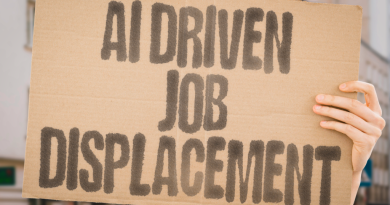
The Labor Fence: AI Comes for White-Collar Work
Goldman Sachs Research estimates that 300 million jobs globally are exposed to AI automation. Stanford’s CodeX lab found that GPT-4 now passes the Uniform Bar Exam at roughly the 90th percentile — a feat impossible for any AI just two years prior.
In a February 2026 interview, Mustafa Suleyman — CEO of Microsoft AI, one of the architects of the modern AI industry — told the Financial Times that AI will likely replace most tasks in white-collar professions within the next year and a half.
“White-collar work, where you’re sitting down at a computer, either being a lawyer or an accountant or a project manager or a marketing person — most of those tasks will be fully automated by an AI within the next 12 to 18 months.”
The cascade has already begun. On Feb. 26, 2026, Jack Dorsey’s fintech company, Block (XYZ) eliminated 4,000 positions: 40% of its workforce. Block’s stock rose 24% in response. In a statement, Dorsey was candid:
“Intelligence tools have changed what it means to build and run a company… the majority of companies will reach the same conclusion within the next year.”
A 12-month timeline for mass professional-class displacement, from one of the most prominent technologists in America.
What followed was swift: Amazon (AMZN) cut 30,000 corporate employees. Meta (META), which had already shed 25,000 jobs since 2022, began tying performance reviews directly to AI usage. Total tech sector job losses in Q1 2026 alone reached 91,600. And the Bureau of Labor Statistics, in its annual benchmark revision, revised down job creation for the year ending March 2025 by 862,000 positions.
AI is coming for the office first, not the factory floor.
The Capital Fence: Why Only Giants Can Compete
Capital is the second fence and, in some ways, the most durable.
The hyperscalers — Microsoft (MSFT), Alphabet (GOOGL), Amazon, Meta, and Oracle (ORCL) — are spending nearly $700 billion on AI infrastructure in 2026 alone.
That kind of capital requirement changes who gets to participate. A small company can build an app on top of AI. It cannot easily build the model, secure the GPUs, sign the power contracts, or finance the data centers required to compete at the foundation layer.
Then come the choke points. Nvidia (NVDA) controls the overwhelming majority of the AI accelerator market, with gross margins above 70%. Taiwan Semiconductor (TSM) is the indispensable manufacturer of advanced AI chips. The result is a market where the productive infrastructure of the next economy is concentrated in a handful of balance sheets, fabs, and supply chains.
That is the capital fence: not a law saying others cannot enter, but an economic structure that makes entry nearly impossible except for those already inside the enclosure.
The Political Fence: Regulation Gets Reframed as a Threat
The final fence is political.
On Jan. 23, 2025 — Day 3 of the new administration — President Trump signed Executive Order 14179, “Removing Barriers to American Leadership in AI.” The language matters. AI was not framed primarily as a labor-market shock, a consumer-protection issue, or a public utility that might require democratic oversight. It became a matter of national competitiveness.
Once AI leadership becomes a national-security and economic-growth priority, anything that slows deployment can be treated as an obstacle. Labor protections, state-level rules, liability standards, environmental reviews, data restrictions — all can be recast as barriers to American leadership.
Then, on Dec. 11, 2025, Trump signed a second executive order directing the Department of Justice to establish an AI Litigation Task Force with a mandate to sue states that attempt to regulate AI. Federal broadband grants were also conditioned on states avoiding what the administration deemed “onerous” AI laws.
That is the enclosure mechanism. The commons being fenced off is not physical land. It is the public’s ability to set local rules around a technology that will reshape work, energy use, privacy, education, and wages. State governments try to build gates; the federal government threatens to remove them. Communities ask for conditions; Washington tells them speed comes first.
The Architects of the AI Enclosure Are In the Room
The architects of this enclosure are not hiding from political power. They are sitting next to it.
After the 2024 election, the procession to Mar-a-Lago began almost immediately: Zuckerberg on Nov. 7; Bezos on Nov. 19; Pichai and Brin in December; Cook in December; Altman in January 2025. All had front-row seats on Inauguration Day. Each of their respective companies donated $1 million to the inaugural fund.
The worldview behind this alignment has been visible for years.
Back in 2014, Peter Thiel wrote “Competition Is for Losers” in the Wall Street Journal. His thesis: the goal of business is to escape competition entirely — to build monopolies so dominant they become permanent. He put $15 million behind J.D. Vance’s Senate campaign — the largest individual Senate donation of its time. Vance later called Thiel’s lecture “the most significant intellectual experience” of his life.
Marc Andreessen published his “Techno-Optimist Manifesto” in October 2023, listing his enemies explicitly. Among them: “Trustworthy AI. Responsible AI. Tech ethics. Safety culture.” It is a statement of intent from someone who helps decide which companies get funded and which ideas get built.
This is a conspiracy theory you can verify because it was done out in the open.
The people building the new AI order have described the world they want, funded the politicians most sympathetic to it, and moved directly into the rooms where policy gets shaped.
History’s Most Important Lesson for Investors
The English land enclosures didn’t just destroy one economic model — they created a new one. And the investors positioned correctly inside that new model compounded wealth across generations.
The landlords who usurped the land; the merchants who supplied the new industrial towns; the builders who financed the canals and roads that connected them; the early industrialists who built factories in cities swelling with ex-farmers looking for work…
All became extraordinarily wealthy.
The Great AI Enclosure follows the same structure. It has its own three-layer investment framework.
The Power Layer: Energy Is the New Land
AI is a massive energy consumer. Goldman Sachs projects that data center power demand will increase 165- to 175% by 2030. The IEA estimates data centers will reach 945 terawatt-hours of consumption by 2030. Microsoft has an $80 billion Azure backlog limited not by demand but by available power.
The utilities and nuclear operators sitting at this choke point are the landlords of the new economy. Constellation Energy (CEG) — the largest nuclear operator in the United States, supplying roughly 10% of the country’s carbon-free electricity — signed a 20-year power purchase agreement with Microsoft, restarting Three Mile Island to fuel AI data centers. Google, Amazon, and Meta have followed with their own nuclear deals. The energy gate is real, and it is being monetized.
The Semiconductor Layer: Toll Roads on Toll Roads
Nvidia’s GPU monopoly is well-known. Less appreciated are the choke points further up the supply chain — the companies that make the tools that make the chips.
You cannot build an advanced AI accelerator without extreme ultraviolet lithography machines; and there is, essentially, one company on Earth that makes them: ASML (ASML), a Dutch firm whose EUV machines cost $200 million apiece and take a year to deliver.
You cannot build advanced nodes without the specialized gases, chemicals, and deposition equipment that a small number of companies supply — among Applied Materials (AMAT), whose deposition and etching tools are present in virtually every advanced chip facility on Earth.
These are toll roads on toll roads — and they’re even less correlated to which AI model ultimately wins.
The Data Center Layer: Owning the New Industrial Real Estate
Data center investment hit a record $61 billion in 2025. Goldman Sachs projects $5 trillion in cumulative global digital infrastructure spending through 2030. The companies that own the land, the buildings, and the power connections — and lease them to hyperscalers on long-term contracts — generate contracted cash flows that compound regardless of the AI race outcome. They don’t need to predict whether OpenAI or Anthropic or Google wins. They just need to own the real estate where the servers live.
The Bottom Line: Pick the Right Side of the Fence
In 1764, the farmers of Wigston Magna watched the commissioners arrive with their surveys and their seals.
They could see what was happening. What they lacked was positioning.
A similar enclosure is underway right now, in the Age of AI. The question isn’t whether to believe it. It’s which side of the fence you’re left standing on.
By the time the fences appeared in Wigston, the ownership structure was already decided.
That’s the risk in every technological revolution: not missing the headline, but missing the infrastructure forming underneath it.
We think that process is happening again right now — across the financial layer forming around the new AI economy itself.
That’s why we’re watching what Elon Musk is building inside X so closely.
Click here to see why.